What it was
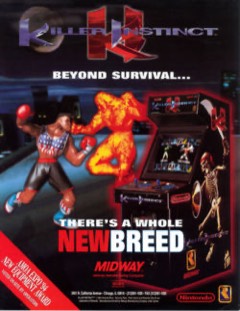
A megacorporation, Ultratech, runs a fighting tournament and enters its own experiments to test them. The cast is the draw: a cloned velociraptor, a werewolf, a skeleton warrior, a man made of fire, an alien made of ice, a cyborg, a Tibetan monk, a boxer stripped of his title for fighting with enhanced arms. The final boss, Eyedol, is a two-headed monster pulled out of another dimension.
It plays unlike other fighters of its time. There are no rounds: each player has two health bars and the match ends when one fighter loses both. Short button sequences set off automatic combos, which can chain into Ultra Combos that pass 20 hits and sometimes reach 80. Against that sits the combo breaker, a move that snaps you out of an opponent's string, and finishers in the spirit of Mortal Kombat, including one that makes the loser dance.
Where it sits in history
Ken Lobb first sketched the idea at Namco in 1993; Namco passed, and he took it to Nintendo of America and then to Rare, which wanted to take on Mortal Kombat. It came out in arcades in October 1994 through Midway, on hardware branded Ultra 64, with an internal hard drive holding pre-rendered characters and backgrounds made on Silicon Graphics computers. The attract mode promised it at home in 1995 on the Nintendo Ultra 64, but that console slipped to 1996.
So Rare brought it to the Super NES instead. Nintendo released it in North America on 30 August 1995 and in PAL countries in September, in a black cartridge rather than the usual grey, backed by a $20 million marketing budget. The first 100,000 US copies came with Killer Cuts, a soundtrack CD by Graeme Norgate and Robin Beanland. It sold 3.2 million copies, more than 150,000 of them in the US on day one.
How it plays today
The port had to shrink a great deal: smaller sprites, simpler stages, still images where the arcade had video, and shorter voice clips. It still looks remarkable for the machine, and it added a training mode, which helps, because the combo system takes learning.
Once it clicks, the push and pull of combo and breaker is thrilling, and it rewards practice in a way few SNES fighters do. The flip side is the one critics raised at the time: a player who knows the combos can flatten a beginner in one long string, so it is best with someone at your own level.
Compared with
Why it matters
The combo breaker is a small rule with a big idea in it. Being on the end of a long combo in most fighting games means waiting it out. Here you can break it, if you read the moment right. The losing player always has a move to make.
Ryan, Rigby and Przybylski found that games feel good when they meet our need for competence and for some say in what happens. Killer Instinct builds that into its rules: even at your lowest, it hands you a way back in, and the comeback becomes the best part of the match.
Read: Who you are when you play →
- Ryan, R. M., Rigby, C. S., & Przybylski, A. (2006). The motivational pull of video games: A self-determination theory approach. Motivation and Emotion, 30(4), 344-360. doi:10.1007/s11031-006-9051-8
What you're levelling up
You have been training these without noticing. Here is how to do it on purpose, and where it pays off away from the couch. All the skills games teach →
Keeping your cool
In the game. An Ultra Combo is coming and you're stuck in a 20-hit string. Mash and you eat all 20. Stay calm, waits for the gap and lands the combo breaker.
Do it on purpose. Open training mode and have a mate run the same string at you ten times. Don't press anything until you can name the exact hit you're breaking on.
Off the couch. Getting grilled in a meeting, copping a sledge from a mate in front of everyone. Hold steady, wait for your opening, then speak. Panic talks too early.
Reading people
In the game. There are no rounds, just two health bars, so you get one long look at how your rival plays. Every combo breaker comes down to guessing when they'll start the next auto-combo.
Do it on purpose. Play your first health bar purely to watch. Count which opener your mate leans on, then spend the second bar breaking it.
Off the couch. On a date, notice which topics light the other person up and which ones they skate past. Ask more about the first, leave the second alone. That's not a trick, it's just paying attention, and heaps of people don't.
Winning and losing well
In the game. A player who knows the combos can flatten a beginner in one long string. Being on either end of that is a test of character.
Do it on purpose. If you're the better player, hand your mate a lesson in training mode instead of a beating. If you're the one getting flattened, ask how they did it.
Off the couch. Teaching instead of gloating makes you the one people want around, at work and on the footy team. Nobody keeps inviting a sore winner.
Verdict · 8/10
A bold, flashy fighter that made the Super NES do things it should not, with a combo system people still talk about. Learn it with a friend, not against an expert.