What it was
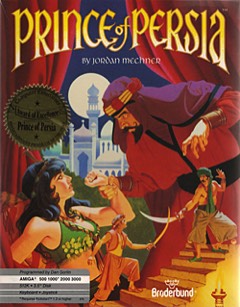
The sultan is away at war, and his vizier Jaffar, a wizard, has seized the palace. The princess gets an ultimatum: marry him or die. You play the nameless young man she loves, thrown into the dungeons, and you must climb out, reach her tower and beat Jaffar before the deadline. On the Super Nintendo the deadline is two hours, not one, because the levels run longer and harder.
Nothing here moves like a normal platformer. You run, leap, hang off ledges and haul yourself up, and every move plays out in full once you start it. The danger comes from spikes, guillotines and pits deep enough to kill outright, plus gates you open by stepping on a plate and then race through before they drop. Swordsmen block the way, and duels are a short dance of advance, back off, slash and parry. Red potions heal, blue ones poison, and a magic mirror spits out a shadow version of you that keeps turning up to make things worse.
Where it sits in history
Jordan Mechner made the original for the Apple II, and Broderbund released it in 1989. He traced video of his younger brother David running and jumping in white clothes, and rotoscoped the sword fights from the Errol Flynn and Basil Rathbone duel in The Adventures of Robin Hood. It sold slowly in North America at first, then took off once it reached Japan and Europe.
The Japanese computer versions, by Arsys Software and Riverhillsoft, gave the Prince his turban and vest, and the look stuck. Arsys then built this SNES version, adding levels with new enemies, traps and music. Masaya published it in Japan in July 1992 and Konami brought it west that November. Mechner praised the changes and said they surprised him in his own game. GamePro, setting it beside the Genesis release, called the two near identical: Sega's had the better graphics, Nintendo's the better music.
How it plays today
The animation still sells it. The Prince has weight. He skids to a stop, catches a ledge by his fingertips and pulls himself up, and a bad jump means watching him drop a floor and wince. That realism is also the friction. You can't change your mind halfway through a move, so new players die on spikes they saw coming and blame the pad. Give it twenty minutes and the rhythm clicks: you start reading each gap before you run at it.
The two-hour clock is the clever bit. Dying sends you back to the start of the level but time keeps running, so failure costs you something real without a lives counter nagging you. The SNES even lets you play on after time runs out, just towards a sadder ending. Sword fights are the weak spot: a few guards in, the parry-then-slash routine stops surprising you. The extra levels earn their place, though, and the long climbs are worth the patience.
Compared with
- Another World: One of the cinematic platformers Prince of Persia inspired, with fewer swords and far stranger scenery.
- Flashback: Another cinematic platformer in Prince of Persia's debt, built on the same careful, weighty movement.
- Karateka: Mechner's first game, and the first time he used rotoscoping to make people move like people.
- Prince of Persia 2: The Shadow and the Flame: The 1993 sequel, for when one palace isn't enough.
Why it matters
Most games forgive you with a fresh life. Prince of Persia takes time instead. Land on spikes and you are back at the start of the level, alive, but the princess's clock hasn't paused for you. It is a gentler and harsher deal at once: no lives to lose, just the knowledge that every mistake spent minutes you won't get back.
Jesper Juul calls this the paradox of failure: we avoid failing in everyday life, then go looking for it in games, because failing is what makes us stop, rethink and improve. Mechner's clock makes the trade visible. You fall, you lose time, you come back sharper, and when Jaffar finally goes down the minutes left on the high score table are a record of everything you learned on the climb. Not a bad way to look at a life, either.
Read: One must imagine Mario happy →
- Juul, J. (2013). The Art of Failure: An Essay on the Pain of Playing Video Games. MIT Press.
What you're levelling up
You have been training these without noticing. Here is how to do it on purpose, and where it pays off away from the couch. All the skills games teach →
Timing and rhythm
In the game. Gates lift when you step on a plate and drop again soon after, so you sprint for the gap. Guillotines kill instantly, so a step taken a beat early ends the run.
Do it on purpose. Pick the gate run that keeps beating you and do it ten times straight, counting the beats from plate to gate out loud.
Off the couch. On a date it's knowing when to ask the next question and when to let the last answer breathe. Nobody relaxes around someone rushing to fill every silence.
Memory and routing
In the game. Dying keeps the clock running, so you can't afford to stumble through the same dungeon twice. You learn which floors hide pits and which potions are poison.
Do it on purpose. After each level, sketch the route from memory: traps, potions, the plate for every gate. Check it on your next run.
Off the couch. Learning a new job fast: where things live, who signs off on what, which shortcut wastes your morning. Remember it once and you stop paying for it.
Keeping your cool
In the game. Your shadow self steals a potion and throws you into a dungeon, and at the end you learn every hit on it hurts you too. Swinging harder is not the answer.
Do it on purpose. When a guard has you down to your last triangle of health, back off and parry before you slash. Loosen your grip on the pad first.
Off the couch. When an argument is going badly, swinging harder rarely helps. Step back, defend, then make your point. Works with your mates and works with your landlord.
Verdict · 8/10
A rotoscoped classic made bigger and harder for the SNES, with a two-hour clock that turns every death into a real cost. The controls ask for patience and pay it back.