What it was
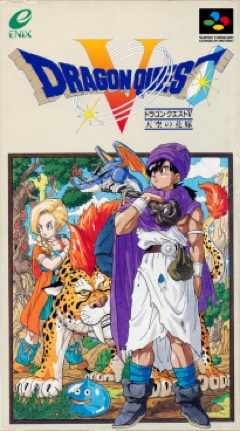
Most role-playing games give you a hero at the start of an adventure. Dragon Quest V gives you a whole life. You begin as a six-year-old boy travelling with his father, Pankraz. You see him lose that father, spend ten years as a slave building a temple, escape, marry, and raise children of his own, all across roughly thirty years. The Japanese subtitle, Tenkuu no Hanayome, means bride of heaven, and choosing that bride is one of the game's big moments.
The other big idea is recruitment. After some battles, a defeated monster may ask to join you, and it then fights and levels up like a human party member. The Super Famicom version has 40 that can join. Battles are the classic Dragon Quest kind, first-person and turn-based, with up to three active party members and the rest resting in a wagon. The tactics system from Dragon Quest IV returns, and you can now also give orders by hand for the whole game.
Where it sits in history
Enix published it on the Super Famicom in 1992, developed by Chunsoft, which left the series after it. Yuji Horii designed the scenario, Akira Toriyama drew the art and Koichi Sugiyama composed the music, the same core team as every earlier Dragon Quest. It was the first in the series on the Super Famicom.
In Japan it was an event. It sold out more than 1.3 million cartridges in its first day and was the country's best-selling home game of 1992, with about 2.8 million sold there by 1993. It was also the first Dragon Quest not localised for North America at the time. English speakers had to wait for the Nintendo DS remake, released in 2009 as Dragon Quest: The Hand of the Heavenly Bride. Its monster recruiting fed into the Dragon Quest Monsters series, and it has been credited as the first game with a playable pregnancy.
How it plays today
The story is the reason to play. Spanning generations gives events real weight: places you visited as a child look different when you return as a father, and the game makes you live with its losses. The monster recruiting adds a collecting habit that keeps battles interesting, and the music is Sugiyama at his most melodic.
The original is harder to recommend than the story. It is in Japanese only, the three-member party limit feels tight, and the random battles and grinding are old-school even by 1992 standards. Unless you read Japanese, a remake is the practical way in; the DS version adds a fourth party slot and an English script.
Compared with
- Dragon Warrior IV: The NES game introduced the wagon, tactics and chapter structure; V builds a single life story on the same systems.
- Final Fantasy IV: Square's SNES story game from the year before is quicker and more theatrical, where Dragon Quest V is patient and domestic.
- EarthBound: Another Super Famicom role-playing game that grounds its adventure in family, with a very different sense of humour.
Why it matters
Most role-playing games hand you a hero. Dragon Quest V hands you a life: a six-year-old travelling with Pankraz, a father lost, ten years of slavery, a marriage, children of your own. Choosing the bride is one of the big moments, and the choice is yours.
James Paul Gee calls it projective identity: a blend of the real self and the character, shaped by what the player wants that character to be. Dragon Quest V gives that blend unusual depth, because you aren't projecting onto one adventure. You're projecting onto a whole biography, grief and all, across roughly thirty years. Meeting your own children in a game can land strangely hard. It hints at the lives we haven't lived yet, or the ones we already have. Even the monster recruiting fits. Defeated enemies ask to join, and a lifetime, it turns out, is mostly made of the people and odd creatures who decide to stay.
Read: Who you are when you play →
- Gee, J. P. (2003). What Video Games Have to Teach Us About Learning and Literacy.
What you're levelling up
You have been training these without noticing. Here is how to do it on purpose, and where it pays off away from the couch. All the skills games teach →
Story sense
In the game. You go from a six-year-old travelling with his dad Pankraz to a father with kids of your own, across about thirty years. Places you saw as a boy look different when you come back a dad.
Do it on purpose. Read every line this session, no mashing. When the bride choice comes, say out loud why you picked her, like you're explaining it to a mate.
Off the couch. Who you spend your life with is the big choice in the game and out of it. Knowing your own story, and being curious about theirs, beats any rehearsed line on a first date.
Picking up a language
In the game. The Super Famicom original never left Japan, so it's Japanese only. If you've played any Dragon Quest you already know what the battle menu does, which is half the battle.
Do it on purpose. Learn the kana for the battle and shop menus first. Keep a notebook of every monster and item you sound out; forty monsters can join you, so that's heaps of reading practice.
Off the couch. A few real words of Japanese gets you further on a trip to Tokyo than any phrasebook. It's also a handy line on a CV.
Planning ahead
In the game. Only three fight at once while the rest wait in the wagon. The monster that asks to join today might be your best fighter in ten hours, if you bother to level it.
Do it on purpose. Before a dungeon, pick your three and write down why. If it goes badly, change one thing only and go again.
Off the couch. Picking the crew for a work project or the road trip. Get the mix right up front and the whole thing runs easy.
Verdict · 9/10
One of the most affecting stories in 16-bit role-playing games, built on plain, reliable Dragon Quest systems. Play a remake if you need English; the heart of it is all there.