What it was
A wanderer named Bartz goes to look at a fallen meteor and ends up trying to protect four elemental Crystals, which also happen to be the seal holding back the sorcerer Exdeath. It is a familiar Final Fantasy setup, told with more jokes than most entries, and the plot is not why people love it.
People love it for the jobs. As the Crystals shatter, their shards unlock classes: Knight, Black Mage, Thief, and newcomers to the series such as the Blue Mage, Time Mage and Mime, 22 in all. Each character can switch jobs freely, earning ability points that level the job and unlock skills. The trick is that a skill learned in one job can be carried into another, so a Knight can also cast black magic, or any job can keep the Thief's Caution skill that stops enemies attacking from behind. Fights use the Active Time Battle system, now with a visible gauge showing whose turn is next.
Where it sits in history
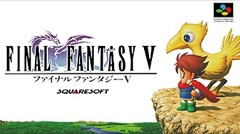
Square released it for the Super Famicom in Japan in December 1992. Hironobu Sakaguchi directed and conceived the story, Yoshinori Kitase added humour to the script, and Hiroyuki Ito designed the job system. Yoshitaka Amano did the image art, Tetsuya Nomura designed the monsters, and Nobuo Uematsu wrote 56 tracks of music. It sold about 900,000 copies on its first day and 2.45 million on the Super Famicom in all.
An English version was started and abandoned several times; Square felt it was too hard and unusual for the Western audience of the day. The game finally reached North America in 1999 on PlayStation, inside Final Fantasy Anthology, nearly seven years late and with a weak translation. The 2006 Game Boy Advance version brought a far better script and four extra jobs.
How it plays today
The job system is as much fun now as in 1992. Building a party is a puzzle you set yourself, and experimenting with odd combinations to break a boss is the heart of the game. The music is among Uematsu's best, and the pace is brisk once the jobs open up.
The story is slight and the cast thinly drawn in the early going, though they grow on you. The random encounter rate is high enough to grate, and some bosses and optional fights demand you understand the system rather than out-level it. The original cartridge was only ever in Japanese, so the official re-releases are the easier route.
Compared with
- Final Fantasy III: The Famicom game's job system is the one V improves on, turning it into something far deeper.
- Final Fantasy IV: The previous entry introduced Active Time Battle and leans on its story; V trades drama for freedom.
- Final Fantasy VI: The next entry keeps the ATB gauge; to our taste it tells the better story, while V is the better toy box.
Why it matters
Final Fantasy V's plot is slight, and nobody minds, because the real story is the party you build. A Knight who casts black magic. A Mime who shouldn't work, and does. Every save file holds a different theory of how to win, and a small portrait of whoever made it.
James Paul Gee called this a projective identity: a blend of the real self and the character, shaped by what the player wants that character to be. The job system turns that idea into mechanics. On paper Bartz is a wanderer; in practice Bartz is whatever you decided at 11pm when a boss kept winning. Your stubbornness, your curiosity, your appetite for a daft combination all end up on the screen. That is why comparing parties is half the pleasure. Nobody is really comparing numbers. They are comparing themselves, and finding out there were twenty ways to be clever.
Read: Who you are when you play →
- Gee, J. P. (2003). What Video Games Have to Teach Us About Learning and Literacy.
What you're levelling up
You have been training these without noticing. Here is how to do it on purpose, and where it pays off away from the couch. All the skills games teach →
Systems thinking
In the game. There are 22 jobs, and a skill learned in one can be carried into another. A Knight who casts black magic, or any job keeping the Thief's Caution so nothing hits you from behind.
Do it on purpose. Pick a boss that keeps beating you. Before you retry, write down what it does and which carried-over skill answers each move.
Off the couch. Work's the same: the skill from your last job is the edge in this one. A tradie who can do sales, a coder who can write. Combos beat specialists more often than you'd reckon.
Curiosity
In the game. Newcomers like the Blue Mage, Time Mage and Mime don't look like they should work. Then you try them and they do.
Do it on purpose. Each session, build one daft party you'd never normally pick and take it through a dungeon. Note one thing that surprised you.
Off the couch. Being up for the odd idea, the karaoke bar, the weird restaurant your date picked, makes you fun to be around. 'Sure, let's try it' is an attractive thing to say.
Bouncing back
In the game. Some bosses and optional fights demand you understand the system rather than out-level it. You'll lose to them at 11pm, more than once.
Do it on purpose. After each loss, name the one thing that killed you, change one job to answer it, and go again straight away.
Off the couch. The knock-back on an application stings. Work out why, change one thing, apply again. The people who land the job are mostly the ones who kept applying.
Verdict · 9/10
A lighter story wrapped around the best character-building system in 16-bit Final Fantasy. Essential for anyone who likes to tinker.