What it was
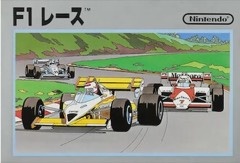
F1 Race is a Formula One racing game for the Famicom, put out by Nintendo in Japan on 2 November 1984. You pick one of two cars and race tracks set among landmark scenery. It plays a lot like Namco's Pole Position: finish two laps inside the time limit and you move on to the next course. Points come from distance travelled, so the goal is a high score.
You get two gears, LOW and HI, and you choose when to shift. Bends punish speed: take one too fast and the car skids toward the outside, then into the scenery or another car. A crash destroys the car and respawns it, usually costing you several seconds. Finishing the first lap earns a time extension.
Three skill levels hold five tracks each, simplest to most complex. The fifth track of every level never ends, no matter how many laps you do. The time bonus for each lap shrinks until the clock beats you. That's the only way those tracks finish.
Where it sits in history
HAL Laboratory built it with a small team led by Satoru Iwata. It was made after Golf and alongside Pinball, Mach Rider and Balloon Fight. In a 1999 interview Iwata described it as a challenge: it was the first Famicom game with raster scrolling, which the system doesn't do by itself, so the team programmed it from scratch. It grew out of Iwata's own love of racing games, the same love that later fed into Nintendo's F-Zero and Mario Kart.
A Game Boy version followed: Japan on 9 November 1990, North America on 3 February 1991 and Europe on 10 October that year. Nintendo R&D1 made that one, with Naotaka Onishi designing. It plays differently, with longer tracks set in different countries, a speed boost on the d-pad and powersliding at sharp corners. Touching another car no longer wrecks you, and hitting the scenery just spins you out. Four people can race over the Game Link Cable, and Mario, Luigi, Peach and the rest turn up at the end of tracks. The Famicom game got two Japan-only sequels, Famicom Grand Prix: F-1 Race and Famicom Grand Prix II: 3D Hot Rally.
How it plays today
It's bare, and that's the charm. Two gears and a clock leave nothing between you and the corner. You learn each bend by crashing at it, and the second go is always better than the first.
Don't expect pace by modern standards. It's an early racer and feels like one. If you like the history, it's a treat: you're feeling the moment someone worked out how to make a Famicom road scroll.
Compared with
- Mach Rider: HAL again, made in the same stretch: a motorbike racer through a wrecked future where you shoot the riders in your way.
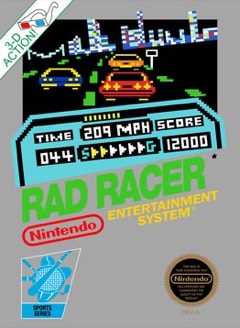
- Rad Racer: Square's 1987 racer, a Ferrari or an F1 car and a 3D mode with paper glasses. Three years on, you can feel how far the road had come.
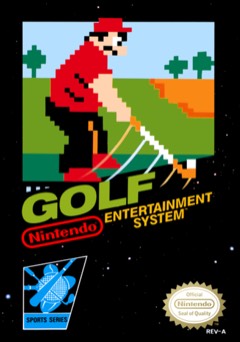
- Golf: The game HAL finished just before this one. Same young team, a much calmer sport.
Why it matters
Csikszentmihalyi described flow as absorption that comes when challenge matches skill, with clear goals and immediate feedback. F1 Race hands over exactly that: one goal, a clock, and a crash the instant you misjudge a bend.
The endless fifth track is the odd bit. It tells you it will end you eventually, and you drive anyway, trying to push the clock out a few seconds further.
Read: The zone: why good games make time disappear →
- Csikszentmihalyi, M. (1990). Flow: The Psychology of Optimal Experience.
What you're levelling up
You have been training these without noticing. Here is how to do it on purpose, and where it pays off away from the couch. All the skills games teach →
Timing and rhythm
In the game. You pick the moment to shift from LOW to HI, and ease off before a bend or skid wide.
Do it on purpose. Run one track shifting only at the same spot every lap.
Off the couch. Knowing when to change up a gear in a conversation: when to make the joke, when to ask the real question, and when to just let them talk.
Judging risk
In the game. Every bend asks if you can carry this speed, and a crash costs seconds you may not have.
Do it on purpose. Take one bend slower than you think you need, and compare lap times.
Off the couch. Merging onto the freeway, asking for an extension, suggesting a second drink. You're reading how much speed the bend can take.
Keeping your cool
In the game. The clock runs down, and panic drives you into the next car.
Do it on purpose. After each crash, breathe once before you touch the d-pad.
Off the couch. The meeting runs over and you're late for the date. One breath before you text, and you send something calm instead of a panicked essay.
Verdict · 6/10
A rough, honest little racer with a big name behind it. Play it for what it shows, not for what it is.