What it was
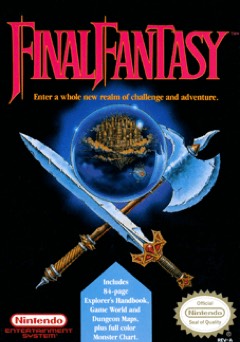
You start by building a party of four from six classes: Fighter, Thief, Black Belt, Red Mage, White Mage and Black Mage. You can't swap anyone out later, so that first screen shapes the whole game. Four mages is a legal choice and a very bad idea.
From there the four Warriors of Light carry darkened crystals across three continents to defeat the four Fiends of earth, fire, water and wind. Travel starts on foot and grows to a ship, a canoe and finally an airship. Battles are turn-based and menu-driven, with your party drawn on the right of the screen and the enemies on the left, a layout the series kept for years. Magic is bought in shops and slotted in, three spells per level per character, with a limited number of casts before you rest.
Where it sits in history
Hironobu Sakaguchi had wanted to make a role-playing game for years, but Square expected poor sales and said no until Dragon Quest proved the genre could sell in Japan. His small team drew on Ultima, Wizardry and Dungeons & Dragons. Akitoshi Kawazu built the battle system and pushed for free class choice; Yoshitaka Amano drew the characters; Nobuo Uematsu wrote the music; Nasir Gebelli programmed it. The name, by several accounts, reflected how precarious things were for Sakaguchi and the company, though he later played that down.
It came out on the Famicom in 1987 and shipped 520,000 copies in Japan, well above the 200,000 Square first planned. Nintendo of America published the English version in 1990, where it sold 700,000. Uematsu's prelude arpeggio, the bridge-crossing theme and the victory fanfare all became fixtures of the series.
How it plays today
The structure is still satisfying. The world opens in clear steps as each vehicle arrives, the dungeons get properly dangerous, and the class upgrade halfway through gives your party a visible reward. There is a real thrill in scraping through a Fiend fight with one character standing.
The NES original is hard work now. You spend long stretches walking in circles to earn experience and gold, the encounter rate is high, and your spell charges run dry deep in a dungeon with no way out but walking back. Later remakes smooth most of that over. Play the original to see where the series began; play a Pixel Remaster to enjoy it.
Compared with
- Dragon Warrior: The game that made Square say yes. Final Fantasy answers it with a full party, classes and side-view battles instead of one hero.
- Final Fantasy II: The sequel throws out experience levels for skills that grow with use, a bolder idea that plays worse.
- Final Fantasy IV: The SNES game swaps build-your-own heroes for a written cast and a real story, and the series never looked back.
Why it matters
Four mages is a legal choice and a very bad idea, and Final Fantasy lets you make it anyway. The first screen hands you six classes and no advice, and every hour after is lived with that choice. Then comes the grind: walking in circles outside a town, fighting whatever turns up, saving for one more spell.
Why would anyone call that fun? Richard Ryan, Scott Rigby and Andrew Przybylski found games satisfy needs for competence, autonomy and relatedness, and that this predicts enjoyment and wanting to play again. Final Fantasy feeds the first two hard. You chose the party, and each level makes the next dungeon survivable. Kent Berridge and Terry Robinson add the awkward part: dopamine drives wanting more than liking. The grind is rarely pleasant in the moment. Wanting keeps you walking in circles, and the class upgrade halfway through finally makes it feel worth it. A game from a company that expected poor sales runs on the most human loop there is: one more fight, then we will see.
Read: Wanting, not liking: what dopamine really does when you play →
- Ryan, R. M., Rigby, C. S., & Przybylski, A. (2006). The motivational pull of video games: A self-determination theory approach. Motivation and Emotion, 30(4), 344-360. doi:10.1007/s11031-006-9051-8
- Berridge, K. C., & Robinson, T. E. (1998). What is the role of dopamine in reward: hedonic impact, reward learning, or incentive salience? Brain Research Reviews, 28(3), 309-369. doi:10.1016/S0165-0173(98)00019-8
What you're levelling up
You have been training these without noticing. Here is how to do it on purpose, and where it pays off away from the couch. All the skills games teach →
Planning ahead
In the game. You build a party of four from six classes and can never swap anyone out. Four mages is legal and a very bad idea.
Do it on purpose. Before a new file, write down why each class is there and what job it does. Halfway through, check whether the reasons held.
Off the couch. Picking a share house or a business partner is a choice you live with for months. Think about the mix up front: who cooks, who pays bills on time, who's fun.
Judging risk
In the game. Spells come three per level with limited casts before you rest. Run dry deep in a dungeon and the only way out is walking back.
Do it on purpose. Set a rule before each dungeon: turn back when your healer drops to a set number of casts. Track whether pushing past it ever paid off.
Off the couch. Knowing when to fold at poker night, or call it a night before the kebab-shop regret, is the same skill. Bank it while you're ahead.
Bouncing back
In the game. There's a real thrill in scraping through a Fiend fight with one character standing, usually after a few goes that didn't.
Do it on purpose. Lose to a Fiend? Before you retry, change one thing only: the gear, the spells or the order.
Off the couch. Asked someone out and got a polite no? Fine. Stay friendly, learn something and keep putting yourself out there. Confidence is mostly bouncing back with practice.
Verdict · 7/10
A founding document of console role-playing games, with a class system that still invites a second run. Honour the original, but play a remake unless you enjoy grinding for its own sake.