What it was
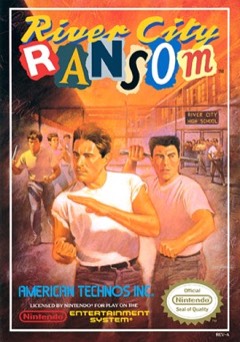
Picture Double Dragon with a wallet. Alex and Ryan cross River City on foot to reach River City High and rescue Ryan's girlfriend Cyndi from a villain called Slick. The streets are full of rival gangs, each in its own coloured t-shirt, each with its own habits and a boss at its head: the Generic Dudes, the Frat Guys, the Jocks, the Squids and five more.
Beaten thugs drop cash. You spend it in shops on food and spa visits that heal you and can raise stats like Punch and Kick for good, or on books that teach new moves such as Stone Hands and Dragon Feet. Steel pipes, trash cans and brass knuckles lie around to swing or throw. The map is open, you backtrack freely, and a password records your stats, money, moves and which bosses are down.
Where it sits in history
Technōs Japan made it in 1989 as Downtown Nekketsu Monogatari, the third Kunio-kun game on the Famicom after Renegade and Super Dodge Ball, and the first built for the console from scratch. It was also the first console game its American arm, American Technos, published on its own. North America knew it as River City Ransom; PAL regions got it as Street Gangs.
Sales outside Japan were modest and reviews split: one French magazine loved it, while a British TV reviewer tore it apart. Its reputation grew later, as players found how much it had squeezed onto one cartridge: an open world, role-playing growth and two-player co-op in a street brawler. Remakes followed on the X68000, PC Engine and Game Boy Advance, and the series is still going.
How it plays today
The fighting holds up better than most NES brawlers. Moves come out fast, weapons are funny, and knocking a gang member into another is a small joy that never wears off. The shopping loop is a clever hook: every fight pays for something, so grinding a street feels like progress instead of padding. With a friend on the second pad it is better again.
It is also short and a bit samey once you know the map. The gangs blur together after a while, the story is thin, and stat numbers can mean grinding before a tough boss. None of that kills it; it just means River City Ransom works best as an afternoon romp rather than a long campaign.
Compared with
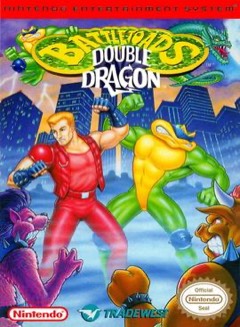
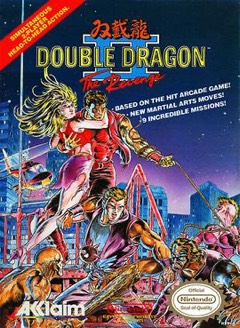
- Double Dragon: The same street-fight basics, but a straight line where River City Ransom gives you a town and a shopping list.
- Super Dodge Ball: The Kunio-kun series in a gym instead of a street, with the same squat, cheerful characters.
- Teenage Mutant Ninja Turtles: Another 1989 NES game that mixes an overworld with action, far less generous to the player.
Why it matters
Why clear one more street? Because the beaten Frat Guy drops cash, the cash buys a book, and the book teaches Stone Hands. River City Ransom worked out in 1989 what whole genres later ran on: make every fight pay for something and people keep fighting long after the fighting itself stops being new.
Kent Berridge and Terry Robinson's work shows dopamine is more about wanting than liking: the pull towards a reward, not the pleasure of it. Wolfram Schultz and colleagues found dopamine neurons signal reward prediction error, the gap between what we expected and what we got. A thug dropping more money than you hoped is that gap in miniature. None of this makes the game cynical. It is a small, funny brawler, and its cleverest trick is how openly it shows the hook. You can feel yourself wanting the next stat bump, laugh at it, and keep punching with a friend on the second pad.
River City Ransom sorts a whole town into gangs and good kids by who swings first. Sociologists have a name for that sorting: Howard Becker’s labelling theory, where “deviant behavior is behavior that people so label”. Our sister site follows the same idea through horror film in its anthology.
Read: Wanting, not liking: what dopamine really does when you play →
- Berridge, K. C., & Robinson, T. E. (1998). What is the role of dopamine in reward: hedonic impact, reward learning, or incentive salience? Brain Research Reviews, 28(3), 309-369. doi:10.1016/S0165-0173(98)00019-8
- Schultz, W., Dayan, P., & Montague, P. R. (1997). A neural substrate of prediction and reward. Science, 275(5306), 1593-1599. doi:10.1126/science.275.5306.1593
- Becker, H. S. (1963). Outsiders: Studies in the Sociology of Deviance.
What you're levelling up
You have been training these without noticing. Here is how to do it on purpose, and where it pays off away from the couch. All the skills games teach →
Planning ahead
In the game. Beaten thugs drop cash, and you choose whether to spend it on healing, stat boosts or books like Stone Hands. Every street is a budget decision.
Do it on purpose. Before you shop, decide which stat you're building and stick to it for a whole session.
Off the couch. Same as a pay cheque: spend it all on snacks or invest in the stuff that makes you stronger. Being good with money is quietly attractive.
Teamwork
In the game. Alex and Ryan crossing River City together, with pipes and bins to throw and gangs to split. Co-op makes it better again.
Do it on purpose. With a mate, take turns being the one who grabs weapons while the other holds the crowd. Swap each street.
Off the couch. A good mate covers you without being asked. Same at work, same on a sports field.
Pattern recognition
In the game. Every gang has its own coloured shirt, its own habits and a boss at its head. Learn the Jocks versus the Frat Guys and you fight smarter.
Do it on purpose. Pick one gang and watch how they come at you before you throw a punch. Name their move.
Off the couch. Noticing who in a group always starts the drama means you can steer around it on a night out.
Verdict · 8/10
A small brawler with big ideas, still funny and still satisfying to punch through. Bring a friend and a free afternoon.