What it was
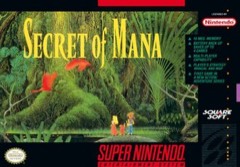
An action RPG for three. A boy pulls a rusted sword from a stone, a girl and a sprite join him, and the three set out to stop an empire from raising an ancient flying fortress. You control one character while the computer runs the other two, and with a multitap two friends can take over those characters at any moment, dropping in and out as they like.
Fights happen in real time on an overhead map. Swing and a power gauge empties; wait for it to refill and your next hit lands at full strength. The Ring Command menu pops up around your character and pauses the action for spells, items and gear. Eight weapon types each level up with use, eight Elemental spirits teach magic, and later a small dragon named Flammie carries you over a rotating Mode 7 world.
Where it sits in history
Square released it in Japan as Seiken Densetsu 2 on 6 August 1993, a sequel to the Game Boy game known in the West as Final Fantasy Adventure. Koichi Ishii directed, Nasir Gebelli did most of the programming and Hiromichi Tanaka produced. It was meant for the SNES CD add-on; when that collapsed, the team squeezed it onto a cartridge and, by Ishii's estimate, lost up to 40 per cent of what they had planned, including branching routes and endings.
Ted Woolsey translated it for North America in 30 days, cutting large parts of the script to fit, and it was on shelves by October 1993. It sold over a million copies in Japan that year, shipped 1.83 million worldwide by 2003, and introduced many Western players to console RPGs. Hiroki Kikuta's score, his first, is still one of the most admired on the system.
How it plays today
With friends, it remains a unique pleasure: a full RPG you play side by side, bickering over who gets the next weapon orb. The world is bright and lush, the music is extraordinary, and the flying map still feels magical.
Alone, the seams show. You can tune how the computer-controlled allies behave, but they still need watching. The power gauge makes combat stop-start, some bosses are just endurance tests, and when too much happens at once the game struggles to keep up. The rushed translation leaves the story thin in English. Expect a charming, flawed adventure rather than a polished one.
Compared with
Why it matters
Secret of Mana let three people into one adventure, and so it gave the 16-bit RPG something the genre had kept to itself: an argument over who gets the next weapon orb. A friend could grab a controller mid-dungeon and put it down for dinner, and the quest carried on without asking permission.
Erving Goffman wrote that a game creates a shared world with its own rules of relevance, and that engrossment together is what makes an encounter feel alive. That is what the multitap bought. Stopping the empire mattered, sort of. Who wasted the last healing item mattered more. Émile Durkheim described collective effervescence, the charged energy of people gathered in one activity, which binds them. A boss falling to three people shouting at once is a small, loud version of it. Alone, the computer allies need watching and the game feels thinner. That is less a flaw than a clue. It was always meant for more than one.
Three friends on one adventure works just as well around a table, with dice instead of a multitap. RPG Creator’s campaign app is built for that kind of evening.
Read: The second controller →
- Goffman, E. (1961). Encounters: Two Studies in the Sociology of Interaction ('Fun in Games').
- Durkheim, E. (1912). The Elementary Forms of Religious Life.
What you're levelling up
You have been training these without noticing. Here is how to do it on purpose, and where it pays off away from the couch. All the skills games teach →
Teamwork
In the game. With a multitap, two mates can drop in and run the girl and the sprite whenever they like. A full RPG side by side, bickering over the next weapon orb.
Do it on purpose. Before a boss, agree who's healing and who's hitting. Afterwards, sort the orb argument fairly, not by who grabbed it first.
Off the couch. Sharing things fairly with mates and flatmates, the bills, the couch, the last beer, is a big part of why they keep you around.
Timing and rhythm
In the game. Swing and the power gauge empties; wait for it to refill and the next hit lands at full strength. Button mashing is the slow way.
Do it on purpose. Fight a whole dungeon only hitting at full gauge. Notice how much faster bosses drop.
Off the couch. Waiting for the right moment, to raise something with your boss or to text back, usually lands better than jumping in. Patience reads as confidence.
Systems thinking
In the game. Eight weapon types each level up with use, and you can tune how the computer allies behave. The party is a machine you set up, then watch run.
Do it on purpose. Change one ally setting at a time and watch a fight. Keep the change only if it actually helps.
Off the couch. Change one thing at a time and watch what happens. Works for training, budgeting, even sorting out your sleep.
Verdict · 8/10
The co-op RPG of the 16-bit era, with a soundtrack to treasure. Play it with friends and forgive its rough edges.