What it was
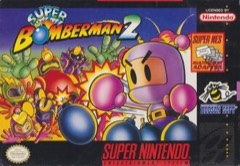
Alone, you walk Bomberman through maze-like areas of blocks, monsters and switches. Lay bombs to clear the monsters and flip every switch, and the gate to the next area opens. Blocks you blow up hide power-ups: more bombs, a bigger blast, more speed, remote-control bombs, bombs you can throw, and a spare hit. There are five worlds, each ending in a boss you fight on foot first, then again inside a giant machine.
The story has five cyborgs, the Five Dastardly Bombers, capturing Bomberman and locking him in their space station. He fights his way out past Magnet, Golem, Pretty and Brain Bomber to their leader, Plasma Bomber.
Battle Mode is the real game. Two players, or four with a multitap, fight across ten arenas built for it, alone or in teams. The new G-Bomber option makes each winner golden and spins a wheel for a power-up to start the next round.
Where it sits in history
Produce! developed it and Hudson Soft published it in 1994: in Japan on 28 April, North America in September and Europe in November. It is the only Super Bomberman game without a two-player story mode.
Famitsu reported 153,587 copies sold in its first week in Japan and 730,000 over its life. Critics loved the multiplayer most. GamePro thought the single-player mode much less engaging. Next Generation gave it five stars, then in 1996 named it the third best game of all time, ahead of the multiplayer games of its own day. GamesMaster called it the best multiplayer game in the world. It came back in 2026 in the Super Bomberman Collection.
How it plays today
With four people on one couch, it is as good as anything made since. The rules fit in a sentence, a round lasts a couple of minutes, and the bomb you placed to trap a friend is just as likely to trap you. Every match ends in a shout.
Alone, it is a pleasant puzzle-action game with fun bosses, but you will feel the gap. This one is for company.
Compared with
- Super Bomberman: The first SNES game, which also had a two-player story mode.
- Super Bomberman 3: The 1995 follow-up, which squeezes a fifth player onto the couch.
- Bomberman: Hudson's 1985 Famicom game, the grid-and-bombs template this one perfects.
Why it matters
Durkheim wrote about collective effervescence: the charged, shared energy of people gathered in one activity, and how it binds them. A four-player Bomberman round is a small, loud version of it. Everyone watches the same screen, everyone knows the same rules, and the moment someone walks into their own blast, the whole room goes up together.
That is why it beat bigger, newer games on Next Generation's list. It is not the bombs. It is the people holding the other three controllers.
Read: The second controller →
- Durkheim, E. (1912). The Elementary Forms of Religious Life.
What you're levelling up
You have been training these without noticing. Here is how to do it on purpose, and where it pays off away from the couch. All the skills games teach →
Winning and losing well
In the game. With four people on one couch, every match ends in a shout, and the bomb you placed to trap a friend is just as likely to trap you.
Do it on purpose. Play ten rounds and congratulate every winner, even when it's the mate who just blew you up.
Off the couch. Laughing at yourself when it goes wrong is the best thing you can bring to a party. It makes people, including the one you're keen on, want to be around you.
Spatial thinking
In the game. A grid, a bomb and a friend standing too close. Every round you're reading the blast lines and escape routes.
Do it on purpose. Before each bomb, look for your way out. If you can't see one, don't place it.
Off the couch. Always knowing your exit, in a crowd, a job you might quit, or a conversation that's going south, keeps you calm.
Reading people
In the game. In Battle Mode the other three players have habits: who chases, who hides, who goes for power-ups. Spot them and you outlast them.
Do it on purpose. Watch one player for a whole round and guess where they'll move next. Count how often you're right.
Off the couch. Reading a group is how you know who's having a good time and who needs a laugh. Great host skill.
Verdict · 9/10
One of the great party games, built on almost nothing: a grid, a bomb and a friend standing too close. Play it with three people you like.