What it was
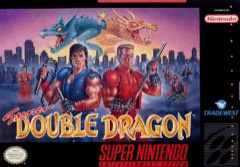
Technos Japan made Super Double Dragon for the SNES, the fourth console game in the series, and it never came to arcades. It's a straight-up brawler: Billy and Jimmy Lee fight the Shadow Warriors gang through seven stages, including a casino, an airport, a dojo, the top of a moving truck, a city slum, a forest and the boss's hideout.
The big change is a guard button. Time it right and you block a punch, and against some enemies you grab their arm and leave them open for a combo. A Dragon Power gauge fills while you hold L or R, letting you pull out special moves like a flying hurricane kick.
Where it sits in history
Tradewest released it in North America in 1992 and in PAL regions in 1993; Technos handled Japan. The lead designer, Muneki Ebinuma, later wrote about what didn't make it. In 2004 he said the plan had been cut-scenes before bosses and between stages, plus a proper ending: a story about the Lee brothers chasing the Shadow Warriors after local martial artists vanish, and a leader named Duke who'd turn out to be a childhood friend. Time ran out. The retail game has no plot at all, and Marian, who's meant to be a police officer helping the brothers, is in the manual but never in the game.
A tweaked Japanese version, Return of Double Dragon, was re-released by Tommo in 2018, with a North American release under its Retroism brand. It has shuffled music, new moves such as getting your boomerang back, different enemy placement and two extra levels before the final fight.
How it plays today
The guard-and-grab loop gives fights a rhythm the earlier NES games lack. Billy and Jimmy even play differently: Billy is agile, Jimmy hits harder, and they have different basic punches.
Play it with a mate. Alone, it's decent. With two, it turns into a proper pub brawl.
Compared with
Why it matters
Goffman wrote that a game creates a shared world with its own rules of relevance, and that being engrossed in it together is what makes an encounter feel alive. A two-player brawler is that in its plainest form: for twenty minutes, nothing matters except who's standing next to you and what's coming from the left.
Ebinuma's cut story sticks with us. The brothers were meant to be chasing something personal. Even without a plot, the game gave two people the one thing a plot is for: a reason to stand back to back. Want that feeling off the couch? Pick something with a shared enemy and a clock: a trivia night, a steep hike, a flat-pack wardrobe at 10pm.
Read: The second controller →
- Goffman, E. (1961). Encounters: Two Studies in the Sociology of Interaction ('Fun in Games').
What you're levelling up
You have been training these without noticing. Here is how to do it on purpose, and where it pays off away from the couch. All the skills games teach →
Teamwork
In the game. Billy and Jimmy fight differently, with different basic punches, so a pair has to cover each other's gaps.
Do it on purpose. Play a stage with a mate and decide who takes the grabs and who finishes. Swap next stage.
Off the couch. Group projects, kitchen shifts, moving house. The pair that splits jobs sensibly gets out first.
Timing and rhythm
In the game. Time the guard button just right and you block a punch and grab the enemy's arm.
Do it on purpose. Take one stage using guard-and-grab only. No wild swinging.
Off the couch. Knowing when to step in and when to hold back, in a fight, a debate or a bad conversation. Pause, then move.
Pattern recognition
In the game. Baker always carries twin dao blades and can't be disarmed. The arm grab only works on Williams, Roper, Steve, Jackson and the Chin brothers.
Do it on purpose. Name each enemy out loud as they enter and say what beats them before you swing.
Off the couch. Reading a customer, a referee or a room. Spotting who's who in the first minute saves you a lot of grief.
Verdict · 7/10
A solid two-player brawler with a smart guard system and a story we never got. Better with a friend.