What it was
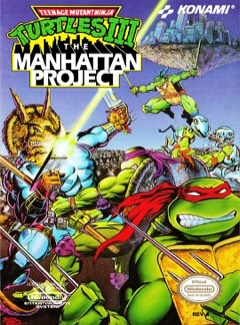
The Turtles are on holiday in Key West when Shredder hijacks April O'Neil's news broadcast, kidnaps her and lifts the whole of Manhattan into the sky. Eight stages later, you have fought from Florida beaches to the floating island, through the Technodrome and Shredder's lair and into Krang's spaceship.
It is a side-scrolling beat 'em up for one or two players, each picking any of the four Turtles. Two buttons cover attack and jump, as before, but this game adds a throw, done by holding down and pressing attack, which flings Foot Soldiers across the screen. Each Turtle also has a special attack on both buttons that costs a sliver of health, unless you are on your last bar. Bosses come from the cartoon, the toys and the second film, and Super Shredder waits at the end.
Where it sits in history
Konami released it on the Famicom in Japan in 1991 and on the NES in North America in 1992. Unlike its predecessor, it was not an arcade conversion but an original NES game built on the same mechanics. Japan knew it as Teenage Mutant Ninja Turtles 2: The Manhattan Project, because the first NES game had a different title there.
The two versions differ in small ways. The Famicom options menu is open from the start, while the NES version hides it behind a form of the Konami Code, and the Famicom cartridge adds a stage select code. Europe never got it until The Cowabunga Collection in 2022. Electronic Gaming Monthly named it the best NES game of 1992.
How it plays today
With a friend, it is great fun. The throw and the special moves give you more options than most NES brawlers, the animation is lively and the stages move through beaches, bridges, sewers and a train. Sharing lives between players keeps a weaker partner in the game, and friendly fire can be switched off.
Alone, it drags. Enemy waves repeat, a few bosses soak up hits for too long, and the angled view sometimes makes it hard to judge whether you are lined up with an enemy. Special moves that drain health are easy to overuse. It is a strong game for its type, but the type is repetitive.
Compared with
Why it matters
Sharing lives between players keeps a weaker partner in the game. That one rule says more about why people play together than most mission statements. Friendly fire can be switched off too. Teenage Mutant Ninja Turtles III assumes a sibling on the couch.
Richard Ryan, Scott Rigby and Andrew Przybylski found games satisfy needs for competence, autonomy and relatedness, and that this predicts enjoyment and wanting to play again. Alone, The Manhattan Project drags; the enemy waves repeat. With a friend, the same waves become a shared rhythm of throws and special moves, and relatedness does the heavy lifting. Erving Goffman wrote that engrossment together is what makes an encounter feel alive. Two kids picking Turtles, one always Donatello, one always arguing, both flinging Foot Soldiers at the screen: that's Goffman's encounter, with pizza. The game is good. The company is the point.
Read: The second controller →
- Ryan, R. M., Rigby, C. S., & Przybylski, A. (2006). The motivational pull of video games: A self-determination theory approach. Motivation and Emotion, 30(4), 344-360. doi:10.1007/s11031-006-9051-8
- Goffman, E. (1961). Encounters: Two Studies in the Sociology of Interaction ('Fun in Games').
What you're levelling up
You have been training these without noticing. Here is how to do it on purpose, and where it pays off away from the couch. All the skills games teach →
Teamwork
In the game. Sharing lives keeps a weaker partner in the game, and friendly fire can be switched off. The stronger player gets to carry the other one home.
Do it on purpose. Play with someone newer than you and make your only goal getting them to the boss alive. Notice what you have to change.
Off the couch. Helping someone newer without making a show of it is what good mates and good bosses do. People remember who carried them.
Judging risk
In the game. Each Turtle's special attack costs a sliver of health, unless you're on your last bar. Easy to overuse.
Do it on purpose. Ration specials to three a stage. Compare the health you finish with against a run where you spam them.
Off the couch. A move that costs you should be saved for when it counts. Same with money, favours and the big speech.
Spatial thinking
In the game. The angled view makes it hard to judge whether you're lined up with an enemy. Plenty of misses are about depth, not timing.
Do it on purpose. Before each swing, line up your Turtle's feet with the enemy's feet, not his head. Count your whiffs this stage against the last.
Off the couch. Judging depth matters on the road, in sport and on the dance floor. Not treading on your partner's feet is a solid start.
Verdict · 8/10
The best Turtles game on the NES and one of the console's best two-player brawlers. Bring a friend; alone, it wears thin.