What it was
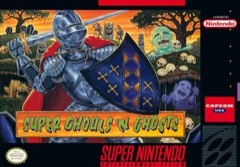
Emperor Sardius has woken the Ghoul Realm and taken Princess Guinevere. The knight Arthur goes after her through eight Quests: a graveyard, a rotting sea, caverns of fire, the inside of a monster, ice, then three stages of Sardius's castle. Each Quest ends with a guardian at the gate, and each runs against a clock.
Arthur starts in steel armour with a lance. One hit strips him to his underpants. The next costs a life. Bronze armour powers up his weapon, and gold armour, new to the series, adds a shield and a charged magic attack. Treasure chests appear only when you cross certain spots, and some of them hold a magician who turns Arthur into a baby, a girl, a seal or a wasp for a while.
This game adds a double jump. A single jump commits you: once Arthur leaves the ground, he goes where he was headed. The second jump is the only way to turn around in the air, and learning to save it is most of the skill.
Where it sits in history
Capcom developed and published it. It came out in Japan on 4 October 1991 as Chō Makaimura, in North America in November, and in Europe in December 1992. It is the third Ghosts 'n Goblins game and the first not made for arcades.
Tatsuya Minami led a staff of about 50, his first time running a team. When he arrived after Final Fight, only the first level existed. The next two years were rough, and the master ROM was remade several times close to the deadline. The good reviews that followed convinced him to keep leading projects.
The Western release turned the church crosses into ankhs and renamed the final boss from Samael to Sardius. The European version removed some enemies and obstacles to cut the difficulty and the slowdown. Electronic Gaming Monthly called it the best game in the series.
How it plays today
It is hard, and it does not apologise. You get six continues, no password and no save, so a full run is one sitting. Nadia Oxford wrote that you have to memorise every pixel. That is close to true, and it is also the pleasure: each attempt you get a little further because you know a little more.
Then the ending tells you that you cannot kill Sardius without the Goddess's Bracelet, and sends you back to the start to find it. In 1991 that felt like a trick. Today it reads as the series being honest about what it is: a game about doing it again, better.
Compared with
Why it matters
Juul calls it the paradox of failure: we work hard to avoid failing in life and then go looking for it in games. Super Ghouls 'n Ghosts is that paradox in its purest form. Arthur losing his armour is a joke, and it is also the game telling you plainly what you got wrong. Every death is a lesson about one jump, one enemy, one chest.
Then it asks you to do the whole thing twice. Camus wrote: 'One must imagine Sisyphus happy.' Pushing Arthur back up the graveyard with the bracelet on your mind, you might find you are.
Read: One must imagine Mario happy →
- Juul, J. (2013). The Art of Failure: An Essay on the Pain of Playing Video Games. MIT Press.
- Camus, A. (1942). The Myth of Sisyphus.
What you're levelling up
You have been training these without noticing. Here is how to do it on purpose, and where it pays off away from the couch. All the skills games teach →
Bouncing back
In the game. One hit strips Arthur to his underpants, the next costs a life, and six continues with no save makes a full run one sitting. Each attempt you get a little further.
Do it on purpose. Set a goal of reaching one new screen each session. Celebrate it, then go again.
Off the couch. Getting knocked back and turning up again, for a job, a sport or someone you're keen on, is what makes people take you seriously.
Memory and routing
In the game. You have to know where every chest and enemy is, because chests only appear when you cross certain spots.
Do it on purpose. Draw the first Quest on paper from memory. Then play it and check what you missed.
Off the couch. Knowing your stuff cold, a speech, a route, your pitch at work, frees you up to relax and be yourself.
Timing and rhythm
In the game. Once Arthur leaves the ground he goes where he was headed. The double jump is the only way to turn in the air, and saving it is most of the skill.
Do it on purpose. Play a stage holding the second jump until the last possible moment. Notice how often you used it too early.
Off the couch. Holding your best line, in a debate or a story, until the right moment makes it land so much harder.
Verdict · 9/10
The hardest fair game on the Super NES, and gorgeous with it. You will die in your underpants a hundred times and come back for the hundred and first.