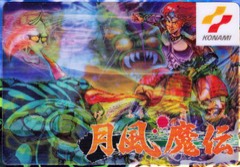
What it was
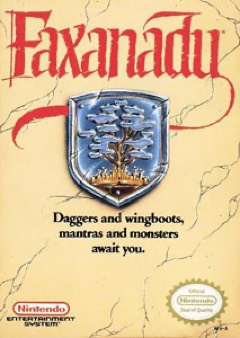
A side-scrolling action role-playing game for the NES. A wanderer, named Nello everywhere outside Japan, comes home to the elf town of Eolis and finds it half empty, the fountain dry, the water poisoned and Dwarves at the gates. The Elven king hands over 1,500 gold and sends him to find out why.
The answer is a meteorite. The Evil One crawled out of it, turned the Dwarves into monsters and set them against the Elves. The Dwarf King, Grieve, swallowed his magic sword before he changed, so the only weapon that can end this is inside him. The journey climbs the World Tree itself: its roots, the inside of the trunk, the branches, then the Dwarves' mountain fortress.
You walk, jump and climb ladders like a platformer, but you also buy swords, armour and magic, earn experience, and talk to townsfolk for clues. Gurus in the churches give you ranks and passwords, which the game calls mantras.
Where it sits in history
Hudson Soft made it under licence from Falcom. It is a spin-off of Xanadu, the second game in Falcom's Dragon Slayer series, and the name joins Famicom and Xanadu. It came out on the Famicom on 16 November 1987; Nintendo published it in North America in 1989 as one of its own titles.
Jun Chikuma wrote the music, with Hudson's sound programmer Toshiaki Takimoto, and used her jazz training to draw chord progressions out of the NES's three tone channels. The game reached number six on Nintendo Power's Top 30 at the end of 1989, and its world turned up in two 1990 episodes of Captain N: The Game Master, with an Elven king who sounded like Elvis. It reached the Wii Virtual Console in 2010 and 2011, and IGN, reviewing that release, called it a hidden gem and a better action RPG than Zelda II or Simon's Quest.
How it plays today
IGN was right. Faxanadu has the brown, sombre look of a world that is dying, and that mood carries it. The town music is lovely and sad. The climb up the tree gives the map a shape you can feel: you are always going up, and always further from home.
The rough edges are the era's. Movement is stiff, the jump is short, and knockback can push you off a ledge. Long passwords are a chore, so write them down carefully. But the loop of grinding a little gold, buying a better sword and pushing one screen further is as moreish as it was, and the game is short enough to finish in a few evenings.
Compared with
Why it matters
Faxanadu starts where most adventures end: coming home. The hero walks back into the town he grew up in and finds it broken. Studies of nostalgia find it is mostly a warm feeling, often about the people we were close to, and that it leaves us feeling more connected. The game uses that pull in reverse. You fight up the tree because you remember what Eolis was meant to be.
Players come back to it for the same reason. Few people played Faxanadu, and those who did tend to talk about it like a childhood street: the music, the brown sky, the long climb up the tree.
Read: Why old games feel like home →
- Wildschut, T., Sedikides, C., Arndt, J., & Routledge, C. (2006). Nostalgia: Content, triggers, functions. Journal of Personality and Social Psychology, 91(5), 975-993. doi:10.1037/0022-3514.91.5.975
What you're levelling up
You have been training these without noticing. Here is how to do it on purpose, and where it pays off away from the couch. All the skills games teach →
Spatial thinking
In the game. The journey climbs the World Tree: the roots, inside the trunk, the branches, then the Dwarves' fortress. You're always going up, and always further from home.
Do it on purpose. Sketch the tree as you climb, marking towns, gurus and shops. Next session, plan your route from the sketch.
Off the couch. Picture where things are in a new office or a new city and you're the one people follow when everyone's lost.
Planning ahead
In the game. The Elven king hands you 1,500 gold. Grind a little, buy a better sword, push one screen further: the loop is all about spending well.
Do it on purpose. Before each shop, decide what you're buying and what you're saving for. Write it down and see if you stuck to it.
Off the couch. First pay after moving out. Rent, food, then the fun stuff. Plan it and you're not living on two-minute noodles in week three.
Keeping your cool
In the game. Movement is stiff, the jump is short and knockback can push you off a ledge. Rush a ladder with an enemy nearby and you lose a screen of progress.
Do it on purpose. When an enemy is near a ledge, stop, let it come to you and fight it on flat ground. Count the falls you save.
Off the couch. First date gone a bit wobbly? Don't rush to fill the gap. Slow down, ask them something, let it come back to you. Calm is attractive.
Verdict · 8/10
A gloomy, handsome action RPG about saving home, with music far better than it needed to be. Stiff to control, but the forgotten gem its fans claim.