What it was
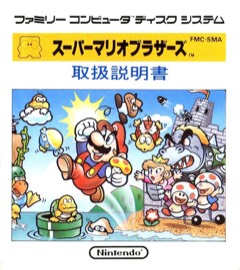
This is the game everyone knows, on a format few outside Japan ever saw. Super Mario Bros. arrived on cartridge in September 1985; on 21 February 1986 Nintendo released it again for the Famicom Disk System, its floppy drive add-on for the Famicom, and only in Japan.
The game itself is unchanged in the ways that matter. Mario runs right through eight worlds of four stages each, stomping Goombas, kicking Koopa shells and hitting blocks for mushrooms, Fire Flowers and the Starman. Each world ends at a castle bridge over lava, and the first seven Bowsers are impostors. Beat it once and a harder second quest replaces the Goombas with Buzzy Beetles, which shrug off fireballs.
Where it sits in history
Shigeru Miyamoto and Takashi Tezuka designed the game, with Toshihiko Nakago of SRD doing most of the programming and Koji Kondo writing the music and every sound effect. Miyamoto wanted the cartridge to be a final exclamation point for the ROM format before the Disk System arrived. There is an irony in it turning up on disk a few months later.
The disk version has one well-documented quirk. On the cartridge, the Minus World glitch drops you into an underwater stage that loops forever. On the disk, the same trick leads to three playable glitch stages: an underwater take on World 1-3 populated by Princess Toadstool, Bowser and Hammer Brothers; a copy of World 7-3; and a recoloured World 4-4 that no longer traps you in a loop. Clear them and the game treats you as having finished it.
The Disk System also carried the Japanese sequel, the harder game later released in the West as The Lost Levels, so this port sits beside its own follow-up on the same shelf.
How it plays today
The design holds up as well here as anywhere. World 1-1 still teaches you everything without a word, the momentum of Mario's run still feels good, and the warp zones still reward the curious. A run through all eight worlds takes an evening at most.
As a way to play, the disk is a collector's route rather than a practical one. You need a Famicom and a working Disk System, both now decades old, and nothing here plays better than the cartridge. The reason to own it is history and that odd, finishable Minus World. For simply playing Super Mario Bros., any official re-release does the job.
Compared with
- Super Mario Bros.: The cartridge original: same levels, same feel, and a Minus World that never lets you out.
- Super Mario Bros. 3: Three years on, the series added a map, suits and far more ideas per world.
- Excitebike: Its scrolling engine let Mario speed up from a walk to a run, and you can feel the family resemblance.
Why it matters
Millions of people carry World 1-1 in their heads: the music, the first Goomba, the first mushroom. On a Japanese floppy disk from February 1986 it all sits exactly where you left it, with a few strange extra rooms behind the Minus World.
That familiarity is the point. Tim Wildschut and colleagues found nostalgia is mostly positive, often features close others, and raises social connectedness and self-regard. Ask someone about Super Mario Bros. and they rarely describe the game. They describe a lounge room, a sibling, a friend's house after school. The disk version makes a neat test case, because almost no one in the West grew up with it, and it still feels like home. The feeling doesn't live in the format. It lives in us, and in the people who were there. A game that teaches everything without a word left a large slice of the planet holding the same memory, and that is a remarkable thing to share.
Read: Why old games feel like home →
- Wildschut, T., Sedikides, C., Arndt, J., & Routledge, C. (2006). Nostalgia: Content, triggers, functions. Journal of Personality and Social Psychology, 91(5), 975-993. doi:10.1037/0022-3514.91.5.975
What you're levelling up
You have been training these without noticing. Here is how to do it on purpose, and where it pays off away from the couch. All the skills games teach →
Curiosity
In the game. Warp zones still reward the curious, and the disk version has an odd, finishable Minus World.
Do it on purpose. Spend one session hunting every warp zone in World 1 to 4. Note how you found each one.
Off the couch. Knowing a few strange, true stories, like a floppy disk Mario only Japan got, makes you fun to talk to at the pub or on a date.
Timing and rhythm
In the game. Mario's run has momentum. Hit the jump at the right speed and the right moment and the castle bridges fall into place.
Do it on purpose. Play World 1-1 trying to never stop running. Note the spots where you hesitate.
Off the couch. Moving with confidence, not second guessing every step, is how good sport and good conversation feel.
Bouncing back
In the game. Beat it once and a harder second quest swaps Goombas for Buzzy Beetles that shrug off fireballs. The finish line is a new start.
Do it on purpose. Start the second quest straight after the first. See which world breaks you and practise that one.
Off the couch. Finishing something and immediately raising the bar, at the gym or at work, is how you keep improving instead of coasting.
Verdict · 9/10
The same essential platformer, on a rarer format with one genuinely interesting glitch. Worth owning as a piece of Famicom history; play the cartridge game or a re-release for everyday use.