What it was
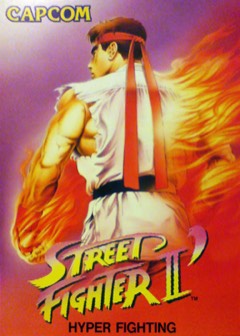
One cartridge, two games. Normal mode is Champion Edition, the previous arcade revision; Turbo mode is Hyper Fighting, faster and rebalanced. In Turbo you set the speed yourself, four steps by default and more with a cheat code.
Hyper Fighting's additions are small on paper and big in play. Chun-Li finally gets a fireball, the Kikoken. Ryu and Ken can throw their Hurricane Kick in the air. Dhalsim can teleport, E. Honda has an anti-air body slam, Blanka rolls upward, and Zangief's lariat gets a faster version. Everyone except Guile and the four bosses gets something new.
Where it sits in history
Capcom released Hyper Fighting to arcades in 1992 as an upgrade kit for Champion Edition boards, less than a year after that version, and it became the highest-grossing arcade game of 1993 in Japan. It was the last Street Fighter II to run on the original CP System hardware before Super Street Fighter II moved on.
The home port reached the Super Famicom in Japan on 11 July 1993, North America in August and PAL regions in October. Capcom built it on the first SNES Street Fighter II, in a larger 20-megabit cartridge, and restored the barrel-smashing bonus stage and the announcer's country call-outs the earlier port had dropped. It sold 4.1 million copies, among the ten best-selling games on the system.
How it plays today
Superbly. The SNES pad suits Street Fighter better than most home controllers of the era, and the speed option means you can play at a pace that suits newcomers or crank it up for friends who know every combo. Characters are distinct, the sprites are big and full of personality, and the balance is good enough that no one feels hopeless.
The single-player mode is where it shows its age: computer opponents can feel cheap, and fighting them alone gets repetitive. Later revisions of Street Fighter II added more to the formula, which some players will want. But as a two-player game on one screen, this is still a great way to spend an evening, and the choice between Normal and Turbo gives it more range than most ports of its day.
Compared with
Why it matters
Against the computer, Street Fighter II gets repetitive. Against the person beside you, it turns into a conversation in a language only the two of you speak right then: a jump-in, a fake-out, the Kikoken Chun-Li finally got. Erving Goffman wrote that a game creates a shared world with its own rules of relevance, and that engrossment together is what makes an encounter feel alive. For a round, nothing outside the screen counts.
In Japan's arcades, Hyper Fighting was the highest-grossing game of 1993. At home the crowd shrank to a lounge room, and the feeling came along. Émile Durkheim called it collective effervescence: the charged, shared energy of people gathered in one activity, which binds them. You can hear it in any room where someone pulls off a comeback. It sounds a lot like being alive, and a lot like being in it together.
Read: The second controller →
- Goffman, E. (1961). Encounters: Two Studies in the Sociology of Interaction ('Fun in Games').
- Durkheim, E. (1912). The Elementary Forms of Religious Life.
What you're levelling up
You have been training these without noticing. Here is how to do it on purpose, and where it pays off away from the couch. All the skills games teach →
Timing and rhythm
In the game. Hyper Fighting is faster, and you set the speed yourself. New moves like Ryu's air Hurricane Kick and Dhalsim's teleport only work if you time them right.
Do it on purpose. Turn the speed up one step each session. Stay there until your anti-airs land every time, then step up again.
Off the couch. Responding at the right moment, in a conversation, a negotiation or a sport, matters more than having the right move ready.
Keeping your cool
In the game. At high speed, whoever panics mashes buttons. The calm one waits for the opening.
Do it on purpose. When you're losing a round, stop attacking for three seconds. Block, breathe, look for the gap.
Off the couch. When someone's winding you up, at the pub or at work, the one who stays calm wins the argument. It's also a good look on a date.
Reading people
In the game. With a friend who talks a big game, you'll spot their favourite Chun-Li Kikoken or Blanka roll within a round.
Do it on purpose. Round one, don't try to win. Watch, name their habit out loud, then punish it in round two.
Off the couch. Reading people helps you know when a mate's bluffing, or when your date is keen on the conversation and when they're ready to move on.
Verdict · 9/10
The best way to play Street Fighter II on a Nintendo console of its era, with two versions in one cartridge. Bring a second controller and a friend who talks a big game.