What it was
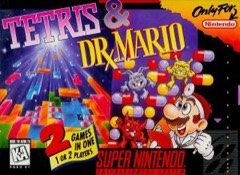
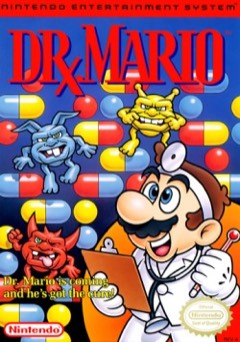
Two of the best puzzle games ever made, on one SNES cartridge in 1994, both remade with a 16-bit coat of paint. They play like the NES versions but use the Game Boy music. Tetris has the A-Type and B-Type modes from the Game Boy and a head-to-head mode. Dr. Mario has viruses to clear with coloured pills, and a two-player mode too.
The reason to own it is Mixed Match. Two players compete for the most points before time runs out, and the game flips between Tetris and Dr. Mario as you go. It begins on Tetris B-Type. You can set the music, time limit and difficulty before you start.
Where it sits in history
It came out in North America in December 1994 and in Europe on 27 July 1995. The Japanese version leaves out Tetris, because Bullet-Proof Software held the console rights to the series in Japan. Dr. Mario was also broadcast through the Satellaview as BS Dr. Mario, and was the last game ever broadcast on that system.
It has sold 6 million copies, which a Kombo writer put down to Mixed Match. Nintendo Power found it appropriately challenging and fun. Both GamePro and Nintendo Power added that if you already owned either game, there might not be much new. IGN ranked it 27th on its list of top Super Nintendo games.
How it plays today
Single-player is just two classics with better controls. Rotate, drop, clear. Nothing here will surprise you, and that's fine because both games are almost perfectly built.
Mixed Match is where it earns the money. You're building lines one minute and matching colours the next, and whoever copes with the switch wins. Grab a mate and give it a go.
Compared with
- Dr. Mario: The NES original of one half.
- Tetris 2: Nintendo's colour-matching Tetris spin-off, which owes more to Dr. Mario than to Tetris.
- Yoshi's Cookie: Another SNES puzzler from the same period.
Why it matters
Ryan, Rigby and Przybylski found that games satisfy three needs: competence, autonomy and relatedness. Mixed Match is the third one on a plate. You share the screen, the clock and the groans, and a puzzle game turns into something to laugh about together.
That's most of what games are for. Two people, one telly, and a rule that flips on both of you at once.
Read: The second controller →
- Ryan, R. M., Rigby, C. S., & Przybylski, A. (2006). The motivational pull of video games: A self-determination theory approach. Motivation and Emotion, 30(4), 344-360. doi:10.1007/s11031-006-9051-8
What you're levelling up
You have been training these without noticing. Here is how to do it on purpose, and where it pays off away from the couch. All the skills games teach →
Spatial thinking
In the game. Tetris wants full lines with no gaps. Dr. Mario wants pill colours lined up on the red, yellow and blue viruses. Same well, two different shapes of thinking.
Do it on purpose. Spend a session looking only for the cleanest, flattest stack.
Off the couch. Packing the boot for a road trip, getting a couch through a doorway, flat-pack without the manual. Same muscle.
Hand-eye coordination
In the game. Rotate, slide and drop pieces as they fall, faster as the levels go on.
Do it on purpose. Play a round using as few button presses as possible.
Off the couch. Anything with your hands under pressure: cooking for friends with three pans going, reversing into a tight park, a drill at the top of a ladder.
Keeping your cool
In the game. Mixed Match flips between Tetris and Dr. Mario mid-match, so your plan keeps getting yanked.
Do it on purpose. When the mode flips, breathe once, then read the board.
Off the couch. When the plan changes halfway, the booking falls through or the band cancels, whoever shrugs and finds plan B is the one everyone wants around. That goes double on a date.
Verdict · 8/10
Two great games, one great mode. Skip it if you already own both and never play against anyone.