What it was
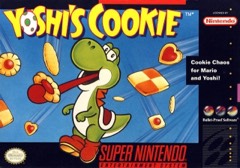
The rule is the same as on the NES. A grid of cookies, a cursor, and rows and columns you slide around like a face of a Rubik's Cube. Line up a whole row or column of one kind and it clears. New cookies push in from the top and right, and if the grid overflows you lose. The Yoshi cookie is a wild card.
The SNES version adds two things. A single-player VS Mode puts you against a computer opponent. And Puzzle Mode gives you set grids to clear in a limited number of moves.
Where it sits in history
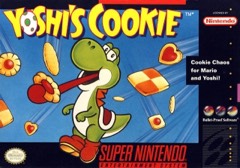
Its story is tangled. Yoshi's Cookie began as Hermetica, an arcade game by Home Data that tested badly. Bullet-Proof Software bought the rights and built a SNES version, designed by David Nolte and shown at the 1992 Consumer Electronics Show. Meanwhile Nintendo licensed the 8-bit versions, put Mario characters in, and released them on NES and Game Boy as Yoshi's Cookie.
Bullet-Proof kept its SNES game, and Nintendo let it use the Mario characters and the Yoshi's Cookie name. Nolte and Yasuaki Nagoshi produced it, and Alexey Pajitnov, who made Tetris, designed the Puzzle Mode levels. It came out in 1993: June in North America, 9 July in Japan, and later that year in Europe.
One oddity: National, a Panasonic brand, made 500 copies of a special Super Famicom edition to promote a microwave oven, with recipes for the cookies in the game. In 2010 a copy was valued at ¥157,500. IGN later ranked Yoshi's Cookie 50th in its top 100 SNES games.
How it plays today
Action Mode still has that calm, moreish pull of sliding a row to finish one line without wrecking the next. Puzzle Mode is the reason to choose this version. It turns the game from a race into a set of small locks: few moves, and a tempting first move that is often wrong.
Compared with
Why it matters
Puzzle Mode is a perfect example of what Suits meant when he described playing a game as 'the voluntary attempt to overcome unnecessary obstacles'. Nobody needs these cookies sorted. The move limit is invented, and so is the grid. We take them on anyway, for the pleasure of the moment the last row clears and the whole thing makes sense.
That pleasure is entirely chosen, which is what makes it ours.
Read: The magic circle: the world that rules make →
- Suits, B. (1978). The Grasshopper: Games, Life and Utopia.
What you're levelling up
You have been training these without noticing. Here is how to do it on purpose, and where it pays off away from the couch. All the skills games teach →
Problem solving
In the game. Puzzle Mode gives you set grids to clear in a limited number of moves, and the tempting first move is often wrong.
Do it on purpose. On each puzzle, find two possible first moves before touching anything, and play both out in your head.
Off the couch. The obvious first move, in a fight with someone you love or at work, often isn't the right one. Pausing to find a second option is what calm, smart people do.
Keeping your cool
In the game. In the single-player VS Mode, the grid keeps filling from the top and right while you race the computer. One panicked slide wrecks the next line.
Do it on purpose. When the grid nears the edge, slow your hands for three moves on purpose. Notice whether you last longer.
Off the couch. When things pile up, deadlines, bills, unread messages, slowing down for three moves beats flailing.
Memory and routing
In the game. Puzzle Mode's grids are set, so once you crack one you can learn the exact sequence.
Do it on purpose. Solve a puzzle, leave it a day, then solve it again from memory without fiddling.
Off the couch. Remembering a sequence, a recipe, a route, a set of directions, makes you the one who doesn't need to look it up.
Verdict · 8/10
The same lovely rule as the NES game, plus a puzzle mode by the man who made Tetris. The better pick if you like to think rather than race.