What it was
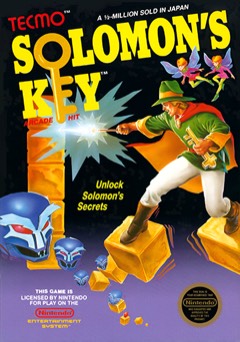
Each room holds a key and a locked door, and a timer runs while you work out how to reach one and then the other. Your wizard, Dana, can run, jump, throw fireballs, and make or break orange blocks next to him; he can also break a block by bumping it twice with his head. Demons keep spawning, and touching any of them kills you. The trick of the game is building your own path a block at a time while the room tries to stop you.
The NES version has 64 rooms. The main 48 come in twelve groups of four, one for each sign of the zodiac, and each group hides a seal in its last room that opens a secret bonus room. More hidden seals unlock three more rooms, and the ending changes depending on which secrets you found. When you finally run out of lives, a 'Game Deviation Value' grades your whole run on rooms, items, time and points.
Where it sits in history
Michitaka Tsuruta designed it for Tecmo, taking Lode Runner as a starting point and adding the power to make blocks as well as destroy them. It began as more of an action game until his boss, Kazutoshi Ueda, suggested puzzles. The look came from Greek myth and the film Jason and the Argonauts. The name came from Tecmo's sales manager, Harano, who liked it when a developer explained that the star symbol in the rooms was the seal of Solomon, and that there was a book called the Key of Solomon.
It started in arcades in 1986 and reached the Famicom in Japan that July and the NES in North America in July 1987. It sold 300,000 copies in Japan. Tecmo followed it in 1992 with a prequel, Solomon's Key 2, called Fire 'n Ice in North America. The NES version joined the Wii Virtual Console in 2006 and Nintendo Classics on Switch on 10 October 2018, and Hamster's Arcade Archives brought the arcade original to Switch in June 2019.
How it plays today
Very well, if you like being outwitted. A room looks impossible, then you see the one block you need to make, and it falls open. The timer keeps you honest, and the demons stop you from thinking too long in one spot.
It is hard, and the hidden seals are properly hidden. Treat it as a puzzle book you dip into, a few rooms a night, rather than something to finish in one go.
Compared with
- Solomon's Key 2: Tecmo's 1992 prequel, known in North America as Fire 'n Ice.
- Lode Runner: The game Tsuruta started from, before he added making blocks to breaking them.
- Mighty Bomb Jack: Tecmo's other 1986 Famicom game, a platformer.
Why it matters
Suits said playing a game is 'the voluntary attempt to overcome unnecessary obstacles'. Solomon's Key is that definition with blocks. The walls are there because someone put them there, and the only way through is to accept them and think.
Csikszentmihalyi found people most absorbed when the challenge matches their skill, the goal is clear and the feedback is instant. Every room here gives you all three: one key, one door, a timer, and a block that either helps or does not. Lose an hour to it and you will know exactly what he meant.
Read: The zone: why good games make time disappear →
- Suits, B. (1978). The Grasshopper: Games, Life and Utopia.
- Csikszentmihalyi, M. (1990). Flow: The Psychology of Optimal Experience.
What you're levelling up
You have been training these without noticing. Here is how to do it on purpose, and where it pays off away from the couch. All the skills games teach →
Problem solving
In the game. A room looks impossible, then you see the one block you need to make, and it falls open. Every room is a riddle.
Do it on purpose. Play a few rooms a night, like a puzzle book. When one stumps you, sketch it on paper before trying again.
Off the couch. Breaking a big problem into one small move at a time works for assignments, tax returns and life admin.
Keeping your cool
In the game. A timer runs and demons keep spawning while you're still working out the room. Think too long and you're dead.
Do it on purpose. When the timer's ticking, slow your thumbs, make one block, and reassess. Don't panic-jump.
Off the couch. Thinking clearly under pressure is huge in a job interview, an exam or the moment a date goes awkwardly quiet.
Curiosity
In the game. Hidden seals unlock secret rooms, and the ending changes depending on which secrets you found. They're properly hidden.
Do it on purpose. Replay a cleared zodiac group hunting only for the seal. Break every block that looks suspicious.
Off the couch. Asking what's behind things, how a job really works or why a mate's quiet, gets you further than taking everything at face value.
Verdict · 8/10
A wizard, a key and a pocketful of blocks, in 64 rooms that each feel like a riddle. One of the cleverest games on the NES.