What it was
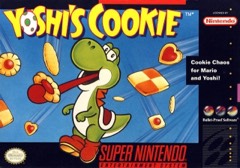
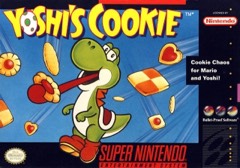
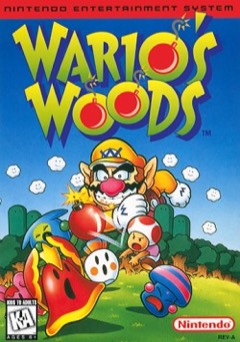
A grid of cookies, five kinds, and a cursor. You slide whole rows and columns around, like turning one face of a Rubik's Cube, and when a row or column is all one kind of cookie, it clears. More cookies push in from the top and the right, and if the grid overflows, the game is over. A Yoshi-shaped cookie turns up now and then as a wild card that matches anything.
Action Mode runs level after level, each a little busier than the last. A VS Mode lets two players race on a split screen.
Where it sits in history
It began as Hermetica, an arcade game by Home Data that did badly in location tests. Home Data sold it to Bullet-Proof Software, and Nintendo licensed the 8-bit versions, gave them to Tose to develop, and put Mario characters in. It came out on the NES and Game Boy together in Japan on 21 November 1992, in North America in April 1993, and in Europe a year after that. The music includes a version of Hermann Necke's Csikós Post.
Reviewers liked it a great deal. Famicom Tsūshin's panel compared its pull to Dr. Mario and found it best with two players; the Washington Post called it simple but addictive; Nintendo Power named it the fifth best NES game of 1993. A SNES version followed from Bullet-Proof Software, with puzzle levels designed by Tetris creator Alexey Pajitnov.
How it plays today
Still lovely. The rule takes ten seconds to learn, and then the game is about seeing two moves ahead while the grid fills, sliding a row to finish one column without spoiling the next. It hits the same part of the brain as Tetris and Dr. Mario without feeling like either.
Later levels get crowded and quick. VS Mode is worth finding a second player for. Save the wild card; the urge to use it at once is almost always wrong.
Compared with
- Dr. Mario: Nintendo's other NES colour puzzle, which Famicom Tsūshin compared it with.
- Tetris: The yardstick every puzzle game of the time was measured against.
- Yoshi's Cookie: The 1993 SNES version, with a puzzle mode designed by Alexey Pajitnov.
Why it matters
Yoshi's Cookie is a near-perfect machine for what Mihaly Csikszentmihalyi called flow. The goal is plain, a row of one kind; the feedback is instant, the row vanishes; and the speed rises just as your skill does. Look up after a long run and the evening is gone.
That it came from an arcade game that failed its tests is worth remembering too. The same idea found its people in a different shape, on a different screen. Sometimes a good thing only needs the right room.
Read: The zone: why good games make time disappear →
- Csikszentmihalyi, M. (1990). Flow: The Psychology of Optimal Experience.
What you're levelling up
You have been training these without noticing. Here is how to do it on purpose, and where it pays off away from the couch. All the skills games teach →
Planning ahead
In the game. You slide rows and columns like a face of a Rubik's Cube, and the game is seeing two moves ahead: finish one column without spoiling the next.
Do it on purpose. Before each slide, say your next move too. Count how often the second move still works.
Off the couch. Thinking two moves ahead is money and work in a nutshell. Whoever can is the one mates ask before they sign the lease.
Deep focus
In the game. Cookies keep pushing in from the top and the right, so there is never a safe moment to look away. Ten minutes in, the rest of the room has gone quiet.
Do it on purpose. Ten minutes, no music, no phone. Notice the moment the grid starts to feel slow, because that's the zone.
Off the couch. Calm focus gets an essay done and a long drive finished. And people notice when your attention is all theirs.
Judging risk
In the game. A Yoshi cookie turns up now and then as a wild card, and the urge to use it straight away is almost always wrong.
Do it on purpose. Hold every wild card for at least three moves this session. Note each time it saved a near-overflow.
Off the couch. Holding a reserve, cash in the bank or a favour you haven't called in, is what lets you handle the bad day.
Verdict · 8/10
A tiny rule that opens into a deep, calm, compulsive game. One more level is never one more level.