What it was
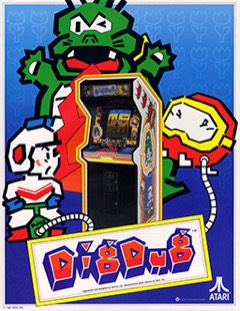
You are a little bloke with an air pump, alone underground, and the dirt is your maze. Nobody hands you a path. You dig it yourself, and every tunnel you cut is one the enemies can walk up too. Down here are the Pookas, round red things in oversized goggles, and the Fygars, dragons who breathe fire sideways along a tunnel.
You have two ways to win. Stick the pump on an enemy and keep mashing the button, and it swells until it bursts. Or dig out the dirt under a rock and let it fall on them. Squash two at once and you score big. Drop two rocks in a stage and a bonus item appears, which you can eat for points. If you stop pumping or move, the hose lets go and the enemy slowly deflates. Enemies can also turn into ghostly eyes and drift straight through the dirt to get at you. They speed up as the crowd thins, and the last one left makes a run for the surface to escape.
Where it sits in history
Masahisa Ikegami planned and designed Dig Dug at Namco in 1981, with help from Shigeru Yokoyama, who made Galaga. The team hoped players could design their own mazes, a contrast with the fixed mazes of Pac-Man. Namco sold it as a "strategic digging game". The arcade game came out in Japan on 20 February 1982, and it was the second highest-grossing arcade game of 1982 there, behind Namco's own Pole Position.
The Famicom version arrived in Japan on 4 June 1985. A Famicom Disk System version, based on that one, followed on 20 July 1990. The Famicom version was re-released in Japan for the Game Boy Advance in 2004 as part of the Famicom Mini series. AllGame called the game an arcade and NES classic, and praised how easily it converted to a home console.
How it plays today
It still reads in a second. Dig, pump, pop. What you notice after ten minutes is how much it's a game about nerve. You want to pump the Fygar right in front of you, but you're standing in his fire lane, and a rock is waiting two tiles above you. Almost every death is one you saw coming and decided to risk anyway.
It's short on flash and long on tension. It's a good one to play in ten-minute bursts: the later stages get faster, the dirt changes colour and the crowd gets bigger, and then your thumb gets sore.
Compared with
- Dig Dug II: The 1985 sequel went overhead and had you jackhammering fault lines to sink chunks of an island. It never caught on like the first.
- Mappy: Namco's 1983 arcade chase: a police mouse robbing back stolen goods from a mansion full of cats, and another one that came home to the Famicom.
- Bubble Bobble: Taito's 1986 arcade game: clear every enemy from a single screen by trapping them in bubbles and popping them. Same itch, cuter bubbles.
Why it matters
Csikszentmihalyi's research on flow says absorption comes when the challenge matches your skill, the goal is clear and the feedback is instant. Dig Dug is almost a lab demo for that. The goal fits in a breath, and the feedback is a pop or a squash. The challenge ratchets up on its own as enemies speed up.
The part that sticks is how personal it is. The danger is partly a thing you dug. That's an odd little lesson to carry out of a 1980s arcade: some of the mess you're in, you made.
Read: The zone: why good games make time disappear →
- Csikszentmihalyi, M. (1990). Flow: The Psychology of Optimal Experience.
What you're levelling up
You have been training these without noticing. Here is how to do it on purpose, and where it pays off away from the couch. All the skills games teach →
Judging risk
In the game. Pumping a Pooka takes several presses while the hose is out and you can't move. Each one is a bet that nothing is walking up behind you.
Do it on purpose. Before every pump, say out loud where the nearest other enemy is. Count how many times you were wrong.
Off the couch. Same read as finishing your point in an argument while you can see the mood turning: is there time to land it, or do you back off and come at it later?
Planning ahead
In the game. Rocks only fall once the dirt beneath them is gone, so you can set up a drop two moves before you need it.
Do it on purpose. Pick a stage, and lay the whole route on paper first: where the rock goes, where the Fygar will be.
Off the couch. Setting up a week of work, a house move or a surprise party so the big moment lands cleanly.
Keeping your cool
In the game. By the last enemy the monsters are at their fastest, and the one left is bolting for the surface. You've got to cut it off without blundering into fire or a rock.
Do it on purpose. On the last enemy of a stage, count to three before you move. See if you lose fewer lives.
Off the couch. Calm in the final ten minutes of a deadline, or the first minute of a hard conversation.
Verdict · 8/10
A tense, tidy little classic that makes you make your own maze and then live in it. Short bursts are the way to go.