What it was
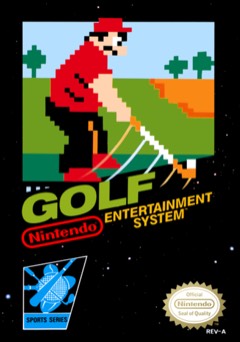
Eighteen holes, one course, and three ways to play: stroke play alone, or doubles stroke play and match play for two. Player one wears white and blue and hits a white ball; player two wears red and hits a red one. Nintendo's 1991 guide book later said the golfer was Mario.
Its swing is the thing every golf game since has borrowed. Golf was the first golf game with a power and accuracy bar for each swing.
Where it sits in history
Nintendo and HAL Laboratory made it, and it came out on the Famicom in Japan in 1984, one of the first seven games for the machine. Shigeru Miyamoto did the character and game design. Satoru Iwata, later Nintendo's chief executive, was the only programmer. North America got it on the NES in 1985, Japan on the Disk System in 1986, and arcades as VS. Golf.
It became the NES's best-selling sports game, over four million copies, 2.46 million of them on the Famicom in Japan. It turned up in Animal Crossing on the GameCube and on the e-Reader, and its courses came back in 3D in Wii Sports. Early Switch firmware hid it as a tribute to Iwata: set the clock to 11 July, the day he died, and make his Nintendo Direct hand gesture with the Joy-Con.
How it plays today
Gently. One course gets familiar fast, and there is not much to see. But the swing is right, and a round goes by quickly.
Played with someone in match play, it turns into a long, quiet argument about who reads the wind better. That holds up.
Compared with
- NES Open Tournament Golf: Nintendo and HAL's 1991 follow-up, with Mario and Luigi on the tee and courses around the world.
- Tennis: Nintendo's Famicom tennis from January 1984, the same early run: one clean idea, done simply.
- Baseball: Nintendo's Famicom baseball from December 1983, a few months older than Golf and just as plain.
Why it matters
Most games leave a credits screen. Golf left a person. A programmer who wrote every line of it went on to run Nintendo, and when he died, the company tucked his first game into its newest machine, waiting for anyone who knew his gesture.
Wildschut found nostalgia is mostly a warm feeling, often about the people around us, and that it leaves us more connected. Golf on that one day of the year is nostalgia built on purpose: a small, shared memorial, opened by a wave.
Read: Why old games feel like home →
- Wildschut, T., Sedikides, C., Arndt, J., & Routledge, C. (2006). Nostalgia: Content, triggers, functions. Journal of Personality and Social Psychology, 91(5), 975-993. doi:10.1037/0022-3514.91.5.975
What you're levelling up
You have been training these without noticing. Here is how to do it on purpose, and where it pays off away from the couch. All the skills games teach →
Timing and rhythm
In the game. Golf was the first golf game with a power and accuracy bar on each swing. Stop it a hair late and the ball goes wide.
Do it on purpose. Play nine holes with one rule: the same rhythm every swing, no rushing the second press. Count how many land where you aimed.
Off the couch. A real golf swing, a cover drive, the dance floor. Rhythm you don't rush looks relaxed, and relaxed looks confident.
Judging risk
In the game. One course, eighteen holes and the wind. Go for the green or play it safe is the whole decision on every long hole.
Do it on purpose. Before each shot, say whether you're going for it or playing safe, and why. Tally which calls paid off over the round.
Off the couch. Money's like that. Go for the green on every hole and you blow up your card. Learn which bets are worth it.
Winning and losing well
In the game. Match play for two turns a round into a long, quiet argument about who reads the wind better.
Do it on purpose. Play match play with a mate and say 'good shot' every time one earns it. Lose a hole? Shake it off before your next swing.
Off the couch. Mini golf on a date tells them heaps about you. Cheer when they sink one, laugh when you shank it. Nobody fancies someone who sulks over a putt.
Verdict · 7/10
Small, plain and foundational: the swing bar starts here. Play a round for Iwata.