What it was
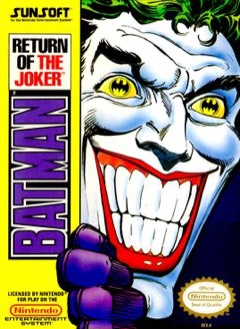
The Joker has stolen a load of metals, one of them toxic enough to build missile warheads, and Gotham sends Batman after him. Seven stages take him from a cathedral to the Joker's warehouse, a snowy mountain, a refinery, an underground conduit, an ammunition base and finally the Joker's island hideout.
Sunsoft's first NES Batman was about fists and wall jumps. This one is a run and gun. Batman fires from a wrist projector, and letter icons change what it shoots: a crossbow whose arrows make enemies explode, Batarangs that track enemies, Sonic Neutralizers that fire in a criss-cross, and Shield Stars that spread three darts. He can slide along the floor, which knocks over some enemies. Collect eight energy capsules and he turns invincible for a few seconds. You have three lives but unlimited continues, and pausing shows a password for the stage.
Where it sits in history
Sunsoft developed and published it in December 1991, with a PAL release in 1992. Its predecessor followed Tim Burton's 1989 film; this one has its own story and leans on the comics, though the film's Batmobile and Batwing still turn up. A Mega Drive remake by Ringler Studios, Batman: Revenge of the Joker, came out in 1992. A Super NES version of that remake was finished and never released. A completely different Game Boy game shares the name.
Critics have kept coming back to the graphics. Syfy Wire ranked it the fourth most essential DC game to play, and IGN in 2019 named its final boss the third best Joker in video games. Nick Wozniak, an artist at Yacht Club Games, has called its Batman sprite one of his all-time favourites, and pointed out that only one or two human enemies are ever on screen because the sprites take so much of the machine.
How it plays today
The look holds up. Batman moves smoothly and with real weight, the colours are dark and moody, and the backgrounds have a depth the NES rarely managed. The bosses fight with numbered life bars instead of the usual blocks, which makes each one feel like a duel.
As a game it is good rather than great. It's less inventive than the first NES Batman, and with so few enemies on screen the stages can feel thin. Unlimited continues and passwords keep it fair, and it's short enough to finish in a sitting.
Compared with
- Batman: The Video Game: Sunsoft's first NES Batman: wall jumps and melee, and the better-designed game.
- Journey to Silius: Sunsoft's other NES run and gun, a year earlier.
- Contra: The run and gun everything on the NES gets measured against.
Why it matters
Everyone who owned an NES knew roughly what it could do. Then this cartridge showed a Batman who looked like he belonged on a 16-bit machine. Pick up eight capsules and he turns gold and mows down a room. Wozniak called it Super Batman and said the developers plainly didn't care about restraint. That's the joy of it.
Schultz found that dopamine neurons respond to the gap between what we expect and what we get. Return of the Joker lives in that gap. People don't remember it for its level design; they remember the moment it looked better than an 8-bit game was supposed to.
Read: Wanting, not liking: what dopamine really does when you play →
- Schultz, W., Dayan, P., & Montague, P. R. (1997). A neural substrate of prediction and reward. Science, 275(5306), 1593-1599. doi:10.1126/science.275.5306.1593
What you're levelling up
You have been training these without noticing. Here is how to do it on purpose, and where it pays off away from the couch. All the skills games teach →
Judging risk
In the game. Letter icons swap your wrist projector between crossbow, tracking Batarangs, criss-cross Sonic Neutralizers and spread Shield Stars. Grabbing the wrong one mid-stage can leave you badly armed for the boss.
Do it on purpose. Pick the weapon you rate least and play a whole stage with it. See if your ranking holds up.
Off the couch. Swapping jobs, switching phone plans, changing gyms. Knowing what you're giving up as well as what you're getting saves heaps of grief.
Pattern recognition
In the game. Bosses have numbered life bars, so each fight is a proper duel where you can see what's working.
Do it on purpose. On each boss, write down its attacks in order before your second try. Check how many you got right.
Off the couch. Spotting the loop in how your manager reacts, or which mate always goes quiet about work, lets you get ahead of it.
Bouncing back
In the game. Three lives, but unlimited continues and a password for every stage. The game wants you to go again.
Do it on purpose. Each continue, say one thing you'll do differently. Only one. Then do it.
Off the couch. Rejected application, bad first date, a workout that went backwards. Same loop: lose, learn, go again.
Verdict · 7/10
A showpiece that still makes people stop and stare. The game under the art is solid, short and a little blunt.