What it was
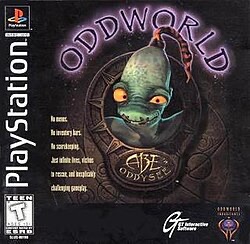
Abe sweeps floors at RuptureFarms, a meat factory on a planet called Oddworld. The animals it grinds up are running out, so the bosses plan a new product: Abe and every other Mudokon worker. Abe overhears. Abe runs.
It plays screen by screen, like a film you push along with your thumbs. Abe can't steer in mid-air. Every step and jump is a commitment, so you look before you leap or you die and go back to the last checkpoint. You sneak on tiptoe past armed guards called Sligs, or you chant, take over a Slig's mind, and walk it around shooting its own mates.
Then there's GameSpeak, the bit nobody forgets. Hold a button and Abe talks: hello, follow me, wait. The other workers answer. You lead them past mines and guards, then chant open a bird portal and send them home. There are 99 of them. Save at least 50 and they come back for you at the end. Leave them, and they don't.
Where it sits in history
Oddworld Inhabitants started on it in January 1995 under the working name Soul Storm. GT Interactive bought it in September 1996 and spent $10 million marketing it, its biggest budget to that point. Director Lorne Lanning said GameSpeak was partly inspired by the sound puzzles in Loom. One creature, the Meech, was cut late because the disc ran out of room, so the story calls them extinct, and the meat shortage is why the factory turns on its workers.
It hit shelves on 18 September 1997, on the PlayStation and PC, a day before a launch the makers called Odd Friday. Lanning reported over a million sold by late January 1998, and 3.5 million by December 2012. Japan got it in October as Abe a GoGo, from SoftBank, with Abe's design changed. Abe's Exoddus followed in 1998, and Just Add Water remade it as Oddworld: New 'n' Tasty! in 2014.
How it plays today
The art still looks like nothing else. Grimy, funny, sad, on purpose. The controls feel heavy at first, and the checkpoint-only saves will cost you a level of progress more than once; reviewers grumbled about both in 1997. Give it twenty minutes and the weight starts to feel like part of the story. Abe isn't an action hero. He's a cleaner having the worst day of his life.
And nothing has bettered the walk home. A line of nervous workers following you, one wrong step from a mine, you whispering "wait" and checking the guard's back. When the bird portal opens and they fly out, it beats any boss you've ever killed.
Compared with
- Another World: The cinematic platformer it grew from: one screen at a time, one mistake and you're dead.
- Flashback: Same heavy, committed movement, with a sci-fi spy story.
- Lemmings: Also about getting a crowd of helpless little people home alive.
- Prince of Persia: Where the realistic, weighty jump started.
Why it matters
Abe could just leave. The door is right there. The game never forces him back for the others; it only counts who he brought. And that score is the whole story: save fewer than half, and nobody comes for you at the end.
That is the oldest deal we have. Michael Tomasello's team argue humans evolved as hunters who depended on their partners, so looking after your partner was looking after yourself. Felix Warneken and Tomasello found babies of 18 months help a stranger, unasked. Abe's Oddysee builds a whole game out of that instinct and never once tells you it's doing it. You just feel it, every time a worker says "OK" and falls in behind you.
Read: Call of Duty: what games are really for →
- Tomasello, M., Melis, A. P., Tennie, C., Wyman, E., & Herrmann, E. (2012). Two key steps in the evolution of human cooperation: The interdependence hypothesis. Current Anthropology, 53(6), 673-692. doi:10.1086/668207
- Warneken, F., & Tomasello, M. (2006). Altruistic helping in human infants and young chimpanzees. Science, 311(5765), 1301-1303. doi:10.1126/science.1121448
What you're levelling up
You have been training these without noticing. Here is how to do it on purpose, and where it pays off away from the couch. All the skills games teach →
Teamwork
In the game. GameSpeak. Say hello, say follow me, say wait. Get the timing wrong and a whole line of workers walks into a mine behind you.
Do it on purpose. Next level, save every single Mudokon on the screen before you move on. No leaving anyone. Count them out loud.
Off the couch. Leading a group is mostly saying wait at the right moment. At work, on a footy trip, at a crowded party with your date: check everyone's still with you before you go.
Planning ahead
In the game. Abe commits to every jump and can't steer mid-air. One look ahead saves you a trip back to the checkpoint.
Do it on purpose. Before each new screen, stop. Spot the guard, the mine and the exit, then move. No moving until you've named all three.
Off the couch. Same rule for money, moving house or a hard conversation. Look at the whole screen first, then commit.
Keeping your cool
In the game. Possess a Slig with Abe's chant and the guard is yours. Panic, start running, and you're both dead.
Do it on purpose. Pick the hardest room you know. Tiptoe the whole thing: no running, no matter what.
Off the couch. The calm one in the room ends up in charge. Slow down when everyone speeds up, and people follow you, just like the Mudokons.
Verdict · 10/10
A game about a worker who refuses to escape alone. Twenty-nine years on, still one of the best ideas anyone has put on a disc.