What it was
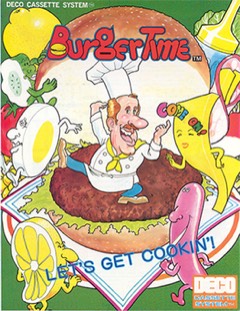
You're chef Peter Pepper, and the burger parts are bigger than you. Each level is a maze of platforms and ladders with buns, patties, tomato, lettuce and cheese hanging in the way. Walk the full length of an ingredient and it drops to the level below, knocking down whatever sits under it. Stack a full set onto the plate at the bottom and you've built a burger. Build them all to clear the board.
Three food baddies chase you: Mr. Hot Dog, Mr. Pickle and Mr. Egg. Touch one and you lose a life. You have a limited supply of pepper, and a puff of it in front of you stuns an enemy for a moment so you can walk straight past. Bonus food (ice cream, coffee, fries) turns up after you've dropped enough ingredients, and gives you extra points and another shot of pepper.
Crush a baddie under a falling ingredient, or drop an ingredient while one is standing on it, and you score. The second way is far riskier, but it pays more and speeds the board up, because the ingredient falls an extra two levels for every enemy caught on it.
Where it sits in history
It started in the arcades in 1982, made by Data East. In Japan it was called Hamburger and first appeared on the DECO Cassette System. Outside Japan Bally Midway distributed it in North America. Game Machine listed Hamburger as the 11th highest-grossing arcade game of 1982 in Japan.
The home ports came thick and fast. Mattel got the rights and put it on Intellivision in 1983, plus the Atari 2600, Apple II and other machines. The Famicom got a version in 1985, the NES in 1987 and the Famicom Disk System in 1988.
It had a long tail too: sequels, a Game Boy version in 1991, a crossover with The Flintstones in 2000, and a 3D update in 2011. Peter Pepper turned up in Wreck-It Ralph and Pixels, and a copy sits in the shop window in Back to the Future Part II.
How it plays today
It's a game about space and timing. You scan the layout, see which ingredient will drop where, and work out whether you can lure a hot dog under it. The first few boards are friendly. By the sixth you're cornered at the edge of a ladder with an egg closing in.
The risk-and-reward loop is honest. Playing safe works but it's slow. Dropping a burger on a baddie is bolder and pays better. A short session is plenty, and it's the kind of game that makes your mates lean in.
Compared with
- Donkey Kong: Platforms and ladders again. Computer and Video Games compared the level layout to it at the time.
- Lode Runner: Another maze of ladders where you outthink the chasers rather than fighting them.
- Bomberman: Both are maze games where you set up a trap and then dodge it.
Why it matters
Bernard Suits defined playing a game as 'the voluntary attempt to overcome unnecessary obstacles'. Nobody needs a burger built by walking across it. That's exactly the point. The silliness is the obstacle, and we choose it.
It also shows how little a game needs. One chef, a few ladders, a handful of angry foods. The fun is entirely in the rules and in us agreeing to care.
Read: The magic circle: the world that rules make →
- Suits, B. (1978). The Grasshopper: Games, Life and Utopia.
What you're levelling up
You have been training these without noticing. Here is how to do it on purpose, and where it pays off away from the couch. All the skills games teach →
Spatial thinking
In the game. You read a maze of platforms and ladders to see which ingredient falls onto which level, and where it will land.
Do it on purpose. Before you move, trace where each ingredient will end up. Do it for the whole board once.
Off the couch. Parking in a tight spot, loading a dishwasher, reading a street directory.
Timing and rhythm
In the game. A puff of pepper only stuns for a moment, and a dropped ingredient only catches an enemy if they're standing under it right then.
Do it on purpose. Wait for Mr. Hot Dog to line up under the patty and don't drop until he does.
Off the couch. Merging into traffic, knowing when to cut in on a conversation, catching a bus.
Judging risk
In the game. Dropping an ingredient on an enemy pays more and finishes the board faster, but it's far riskier than crushing one.
Do it on purpose. Take the risky drop on every board for one session and count the lives it costs you.
Off the couch. Asking for the raise, going for the overtake, pitching the bigger idea.
Verdict · 7/10
A silly, sharp little maze game. Short bursts, real tension. Worth a go.