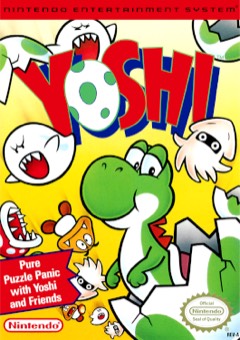
What it was
Four columns, a black line across the top, and Mario standing underneath with one move: swap two neighbouring stacks. Goombas and friends fall from above and pile up. Drop a monster onto a matching one and both vanish. Let any stack cross the line and it's over.
The twist is the egg. Two halves of a Yoshi eggshell fall with the monsters. When a top half lands on a bottom half, everything trapped between them is cleared, and a Yoshi hatches. Trap more, and a bigger Yoshi hatches for bigger points. A-Type runs until you crack. B-Type is a run of levels where you clear the whole field. Two players race side by side, Mario against Luigi, first to three wins.
Where it sits in history
It was Game Freak's first job for Nintendo, and Nintendo had passed on publishing the studio's first game, Mendel Palace. Tsunekazu Ishihara suggested small games like this one would keep the company afloat until it could build its big project, the RPG series Pokémon. Satoshi Tajiri directed, Ken Sugimori came up with the idea, Shigeru Miyamoto and Ishihara produced, and Junichi Masuda did the music. It took six months.
Tajiri has said this is where he learned a difficulty 'wave': an easy stage straight after a hard one, so you get to enjoy what you just beat. It came out on the Famicom and Game Boy together in Japan on 14 December 1991, and everywhere else the year after, as Mario & Yoshi in PAL regions. It sold 500,000 copies in Japan on its first day. In 2024 the Game Freak leak turned up a prototype of an unreleased Nintendo DS remake.
How it plays today
Honest answer: it's thin. Retrospective reviewers called it repetitive and too dependent on luck, and Hardcore Gaming 101 ranked it the weakest of Nintendo's puzzlers next to Dr. Mario and Yoshi's Cookie. Fair. You spend a lot of the game waiting on the right monster to show up.
But the egg is still a good idea. Building a tall, ugly stack on purpose, then dropping the top half to wipe it in one go, is a real hit. Play it in short bursts, which is exactly how N-Force put it in 1992, and with a mate on the second pad.
Compared with
- Dr. Mario: Nintendo's other NES puzzler, which one critic found the better of the two.
- Yoshi's Cookie: Another Yoshi puzzler a year later, from a different studio, which one critic called uninspired next to this.
- Tetris: The yardstick N-Force used: the fun of Tetris, with colour and sound.
Why it matters
Tajiri's wave is flow, designed on purpose. Csikszentmihalyi's work says absorption comes when challenge matches skill. Too hard and you panic; too easy and you drift off. An easy stage after a hard one is a breath that lets the next challenge feel fair.
It's also a story about small things carrying big ones. A six-month side job was part of what kept a studio going until it could make Pokémon. Plenty of good things start as the humble job that paid the rent.
Read: The zone: why good games make time disappear →
- Csikszentmihalyi, M. (1990). Flow: The Psychology of Optimal Experience.
What you're levelling up
You have been training these without noticing. Here is how to do it on purpose, and where it pays off away from the couch. All the skills games teach →
Pattern recognition
In the game. Four monster types fall into four columns. You learn which stack each one will land on, and where the egg halves will fit.
Do it on purpose. Before a monster lands, say which stack it hits. Count how many you call right in a run.
Off the couch. Same skill spots the mate who always bails at 11pm. Seeing it coming is half of being ready for it.
Planning ahead
In the game. You build a tall stack on purpose so the top half of an egg can wipe it in one drop, and a bigger Yoshi hatches for it.
Do it on purpose. Hold off clearing for a few drops and set up one big egg. Note what the bigger payoff cost you in risk.
Off the couch. Saving for the big thing instead of spending on each small one is the whole of money, and most of planning a good weekend.
Winning and losing well
In the game. Two players race Mario against Luigi, first to three wins, and luck decides a fair few of the rounds.
Do it on purpose. Lose a round, say 'good one', and ask for the next. No excuses about the pieces you got.
Off the couch. How you take a loss you partly didn't earn tells everyone watching what you're like to be around.
Verdict · 5/10
A small, lucky puzzler with one great idea in it, the egg. Worth ten minutes. Not worth an evening.