What it was
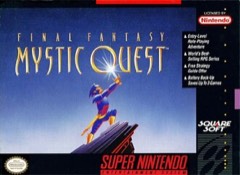
Benjamin climbs the Hill of Destiny, an earthquake flattens his village, and an old man tells him he is the knight of a prophecy. Four monsters have stolen the four crystals of earth, water, fire and wind, and the land is dying region by region. Get them back.
Everything the main series asked of you has been taken away. There are no random battles: enemies stand still in the dungeon and you choose whether to walk into them. You can't wander the world map, only hop along paths from one icon to the next. New armour equips itself, spells come from chests rather than levels, and you save anywhere. In their place come things Final Fantasy never had: a jump button, and weapons that work outside a fight. The axe cuts trees, bombs open walls, and the Dragon Claw doubles as a grappling hook.
Where it sits in history
Square built it in Japan for the United States. Console role-playing games were a small genre there, and Square's executives blamed difficulty, so this one was pitched as a simplified RPG for the entry-level player and priced at US$39.99 to reach younger buyers. It came out in North America in 1992, then in Japan in 1993 as Final Fantasy USA: Mystic Quest. In Europe it became Mystic Quest Legend, the first Final Fantasy released there, renamed because Final Fantasy Adventure had already come out there as Mystic Quest.
Translator Ted Woolsey said it was one of the easiest games he ever translated, because it was so small. Square's publicity department put sales at 800,000, about half of them in Japan. It didn't make Americans love the genre, and fans waiting for a follow-up to Final Fantasy IV felt short-changed. Later reviews were harsher still: Kotaku headlined its Virtual Console review 'The Worst Final Fantasy'. The one thing critics keep praising is the soundtrack by Ryuji Sasai and Yasuhiro Kawakami, heavy on sampled rock guitar.
How it plays today
It is short, it is easy, and it never wastes your time. Seeing every fight before you take it, saving whenever you like and clearing out a battlefield in ten rounds for a prize all feel modern now. The puzzles, like sliding ice pillars to make a path across the Falls Basin, are more than most RPGs of 1992 bothered with.
What it lacks is depth. Battles repeat, the plot is thin, and the people you meet barely have time to become characters. Play it as a gentle weekend RPG, or as a first one for a child, and turn the volume up.
Compared with
- Final Fantasy IV: The full-size Super Nintendo epic Mystic Quest was cut down from in spirit.
- Secret of Evermore: Square's other SNES role-playing game aimed at Americans, this one built in Redmond, Washington.
- Soul Blazer: Another early SNES adventure about restoring a ruined land piece by piece.
Why it matters
Lev Vygotsky wrote that in play a child stands 'a head taller' than themselves: play stretches people just past what they can already do. Mystic Quest was built to do exactly that for a child who had never touched an RPG. It took the genre's hard parts away so the stretch was small enough to make.
The people judging it were already a head taller. To them the missing pieces looked like a cheap game. To a nine-year-old in 1992 they may have been the only way into a genre that was otherwise a wall of menus.
Read: Who you are when you play →
- Vygotsky, L. S. (1978). Mind in Society: The Development of Higher Psychological Processes.
What you're levelling up
You have been training these without noticing. Here is how to do it on purpose, and where it pays off away from the couch. All the skills games teach →
Problem solving
In the game. Weapons work outside a fight: the axe cuts trees, bombs open walls and the Dragon Claw doubles as a grappling hook. Sliding ice pillars across the Falls Basin is a proper puzzle.
Do it on purpose. When you're stuck, list every tool you've got and what it does outside a fight. Try each one before you look anything up.
Off the couch. Using what's already in the shed, or the skills you already have, is half of fixing anything. Whoever can MacGyver it gets called first.
Judging risk
In the game. No random battles: enemies stand still and you choose whether to walk into them. Battlefields clear in ten rounds for a prize.
Do it on purpose. Before each fight, weigh what you gain against what it costs. Skip one you'd normally take and see if you miss it.
Off the couch. Not every fight's worth having, at work, with mates or over the dishes at home. Pick the ones that matter and keep your energy for them.
Winning and losing well
In the game. It was built as a first RPG: save anywhere, gear equips itself, every fight in plain view. Easy for you, maybe, and perfect for someone who's never played one.
Do it on purpose. Hand the pad to a younger sibling or a mate who doesn't game. Coach without grabbing the controller and let them win the fights.
Off the couch. Teaching someone a thing you're good at, without showing off, makes a great date. Patience, a laugh when it goes wrong, and them winning is the point.
Verdict · 6/10
A small, kind RPG that set out to teach, and that critics still punish for not being something bigger. Worth a weekend for the boss music alone.