What it was
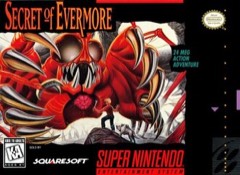
A boy in Podunk, USA follows his dog into an abandoned mansion, the dog chews through some wires in a hidden lab, and the pair land in Evermore. It is four worlds, each someone's private dream: Prehistoria with cavemen and dinosaurs, Antiqua with a colosseum and pyramid, Gothica with castles and dragons, and Omnitopia, a space station. The dog changes with each one, into a wolf, a greyhound, a poodle and finally a robot that looks like a toaster and fires lasers. The boy keeps comparing his situation to B movies that do not exist.
It plays like Secret of Mana: real-time fights, a ring menu, and a gauge that has to refill before you swing at full strength. You control the boy or the dog while the game runs the other. Magic is alchemy. Alchemists teach you formulas, each formula needs a pair of ingredients such as wax and ash, and the dog sniffs those ingredients out of the ground. Each world has its own money, and the markets run on bartering rice, spices and tapestries.
Where it sits in history
Square built it at its office in Redmond, Washington, starting in early 1994, with a new team asked for an American-flavoured game in the style of Secret of Mana. Its working title was Vexx and the Mezmers. To save memory it is single-player only. It was the first game score for Jeremy Soule, who wrote ambient, low-key music for it.
It came out in North America on 17 October 1995 and in Australia in February 1996, and a planned Japanese release was cancelled. People often say it was made instead of a Secret of Mana sequel; its lead programmer, Brian Fehdrau, has said otherwise, and that the team was newly hired and would not have existed without it. Reviews praised the graphics and found it short of Square's own Japanese games.
How it plays today
Its charm is its own. The B-movie jokes, the dog's changing shapes and the trading markets give it a personality nothing else from Square has, and the alchemy system makes you look around each world for ingredients rather than just grind levels.
The combat is its weak side: the gauge can feel slow, and the computer-run partner is not bright. Go in expecting a quirky adventure rather than a Square epic, and it is a good one, and the dog is the best character in it.
Compared with
- Secret of Mana: The game whose menus and combat it was built from.
- Chrono Trigger: A Square SNES game localised while this one was being made.
Why it matters
Every world in Evermore is somebody's dream made solid: a librarian becomes a queen, a museum curator rules ancient Antiqua, the professor's niece leads a tribe. Each of them stepped into a place where they could be the person they wished they were, and thirty years on they are still there.
Przybylski and colleagues found that games pull us in most when playing a character brings us closer to our ideal self. Secret of Evermore makes that its plot, and then gently asks the question underneath it: what do you bring home from the world where you were your best self?
Read: Who you are when you play →
- Przybylski, A. K., Weinstein, N., Murayama, K., Lynch, M. F., & Ryan, R. M. (2012). The ideal self at play: The appeal of video games that let you be all you can be. Psychological Science, 23(1), 69-76. doi:10.1177/0956797611418676
What you're levelling up
You have been training these without noticing. Here is how to do it on purpose, and where it pays off away from the couch. All the skills games teach →
Curiosity
In the game. Alchemy needs ingredients like wax and ash, and the dog sniffs them out of the ground. The game rewards looking around each world rather than grinding.
Do it on purpose. Next session, let the dog lead. Follow every sniff and make a list of what turns up where.
Off the couch. Curious people are interesting. Ask someone what they're into and follow up properly. It's half of being good on a date.
Problem solving
In the game. Each world has its own money and markets that run on bartering rice, spices and tapestries. Getting what you need means working out the trade chain.
Do it on purpose. When you want something at a market, map the trades backwards on paper before you buy anything.
Off the couch. Working backwards from what you need is how you sort out a bond, a car loan or a messy uni timetable.
Story sense
In the game. Four worlds, each someone's private dream, and a boy who keeps comparing his life to B movies that don't exist. It's a game about the stories people make.
Do it on purpose. Talk to every person in a town before moving on. Work out whose dream this world is before the game tells you.
Off the couch. Getting why people do what they do makes you a better mate and better company. Everyone's living in some story in their head.
Verdict · 7/10
An odd, likeable one-off, with real wit and atmosphere and clumsy fights. The only Square game with Podunk in it, and worth a weekend.