What it was
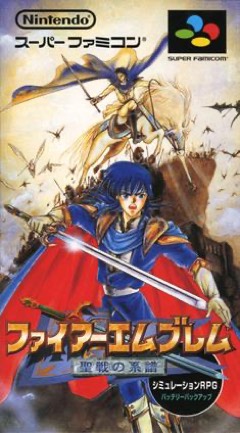
A tactics game that decides to be a saga. You push little units around a grid, one move and one attack each, and lose them for good if they fall. That much is Fire Emblem. What's new is the scale. The maps are huge, the story spans two generations, and the war on the continent of Jugdral starts with Sigurd and ends with his son Seliph.
The rules grew teeth here. The weapon triangle makes its debut: lances beat swords, swords beat axes, axes beat lances. Magic has its own triangle of fire, lightning and wind. Some commanders carry a Leadership rank that boosts every ally within three tiles. Take a castle and the neighbouring one sends reinforcements. You also get a home base between missions, where you repair weapons, shop and fight in the arena.
Where it sits in history
Shouzou Kaga directed, designed and wrote it, with Yuka Tsujiyoko on music, Katsuyoshi Koya on character art and Gunpei Yokoi producing. It was Yokoi's last Fire Emblem. Production was rough: staff changed over, the team moved offices, and romance and a bigger story were added late. One developer later estimated the game was remade two or three times along the way. It was first shown as Inheritors of Light, slated for March 1996, and came out on 14 May 1996.
It sold 494,216 copies in its first print run, the second biggest in the series at the time. It never left Japan. The Wii, Wii U and New Nintendo 3DS got it through Virtual Console in 2007, 2013 and 2016, but it was never localised. English players know it from a fan translation.
How it plays today
It's the ambitious one, and it shows. RPGamer praised the clean, easy-to-learn rules and the emotional story, then flagged a difficulty spike after the first two chapters. Famicom Tsushin's four reviewers scored it 9, 6, 8 and 8, the lowest average of any Fire Emblem on the system.
It's also the game that gave the series its best habits. The weapon triangle, the deeper Support conversations and the idea of characters passing things down to a new generation all turn up again in later games. If you've played Awakening, you've met its grandchild.
Compared with
Why it matters
Kaga wanted a story where the descendants of one team of heroes end up on opposing sides, and the line between good and evil blurs. Arvis conquers because he wants to end discrimination against members of the Loptous bloodline. That's a villain with a reason, which is rarer in games than it should be.
And then there's the second half. You spend a generation raising an army, then hand its children a war their parents started. Self-determination research, like Ryan, Rigby and Przybylski's, says games feel good when they meet our need for competence, autonomy and relatedness. Here the relatedness is the whole point: you're not just winning, you're keeping people alive who matter to the story.
Read: The second controller →
- Ryan, R. M., Rigby, C. S., & Przybylski, A. (2006). The motivational pull of video games: A self-determination theory approach. Motivation and Emotion, 30(4), 344-360. doi:10.1007/s11031-006-9051-8
What you're levelling up
You have been training these without noticing. Here is how to do it on purpose, and where it pays off away from the couch. All the skills games teach →
Planning ahead
In the game. Maps are huge, and seizing one castle triggers reinforcements from the next. Every move changes what the enemy does a few turns later.
Do it on purpose. Before each turn, say out loud what the enemy will do in response. Check after.
Off the couch. Same habit makes you the one who books the venue before it's full, and doesn't get blindsided by the bill.
Judging risk
In the game. Units that fall are gone for good, and the weapon triangle means a bad match-up can wipe out your best fighter.
Do it on purpose. Pick the safe unit for the front line for one chapter. Then try a risky one and note what it cost.
Off the couch. Knowing which bets you can afford to lose is most of money, and most of picking the fights worth having.
Teamwork
In the game. Married characters and siblings who stand next to each other get a critical hit boost, and thieves can pass gold to anyone adjacent.
Do it on purpose. Park pairs together on purpose for a map and watch what they cover for each other.
Off the couch. Good teams work out who covers whom before the pressure hits. Good partners do too.
Verdict · 8/10
A huge, brave tactics game that trades polish for scale, and the series learned from every part of it. Worth the fan translation if you like long wars and bigger stakes.