What it was
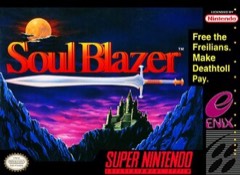
An action role-playing game with a lovely central idea. An evil spirit called Deathtoll has emptied the Freil Empire, locking every living soul inside monster lairs. You are a heavenly servant of The Master, sent down with a sword. Clear a lair and a soul comes free: a villager, a dolphin, a flower that talks. The town rebuilds itself around them, one house at a time.
So you go back and forth between the cleared town and the dungeon next door, and each trip the town gets fuller and the people have more to tell you and give you. Free a region's leader by beating its boss and you move on. Six regions, six stones, and then the World of Evil.
Where it sits in history
Quintet developed it and Enix published it. It came out in Japan on 31 January 1992 as Soul Blader, reached North America the same year and Europe on 27 January 1994, though never the United Kingdom. Yukihide Takekawa wrote the music.
Electronic Gaming Monthly gave it its Editor's Choice Gold award and compared it well with The Legend of Zelda: A Link to the Past. Quintet reported 295,000 copies sold worldwide: 200,000 in Japan, 70,000 in North America and 25,000 in Europe.
Fans group it with Illusion of Gaia and Terranigma as an unofficial trilogy, but Enix USA's producer said it has no link to Gaia and is instead a sort of prequel to ActRaiser, Quintet's god game. It has never been re-released.
How it plays today
The rebuilding loop still works beautifully. There is a real pleasure in walking back into a town you have restored and finding someone new on the step. The combat is plainer than Zelda's, a sword and a few soul helpers, and the dungeons can drag.
The story turns surprisingly sad: an inventor, a greedy king, a bargain of gold for souls. The ending is gentle. If you can find a cartridge, play it with patience and talk to everyone, including the plants.
Compared with
Why it matters
Most games measure progress by what you take: points, loot, ground. Soul Blazer measures it by who comes home. Wildschut and colleagues found that nostalgia mostly features close others and raises our sense of connection. This game seems to know that feeling from the inside. Each freed soul is a small homecoming, and the reward for winning is a street with neighbours on it.
We are, it turns out, the kind of creature that will walk past a hundred monsters to hear a tulip say thank you.
Read: Why old games feel like home →
- Wildschut, T., Sedikides, C., Arndt, J., & Routledge, C. (2006). Nostalgia: Content, triggers, functions. Journal of Personality and Social Psychology, 91(5), 975-993. doi:10.1037/0022-3514.91.5.975
What you're levelling up
You have been training these without noticing. Here is how to do it on purpose, and where it pays off away from the couch. All the skills games teach →
Curiosity
In the game. Each soul you free rebuilds the town, and every trip back people have more to tell and give you. Talk to everyone, including the plants.
Do it on purpose. After each lair, walk the whole town and talk to every new face before heading back out.
Off the couch. Taking an interest in people, actually asking how their week was, is one of the most attractive things you can do.
Bouncing back
In the game. Dungeons can drag and you go back and forth between town and lair over and over. Progress comes in small steps, one freed soul at a time.
Do it on purpose. When a dungeon feels slow, set a goal of freeing three souls and stop there. Notice how much the town changed.
Off the couch. Small wins add up. Rebuilding after a bad breakup or a lost job works the same way, one step at a time.
Story sense
In the game. The story turns surprisingly sad: an inventor, a greedy king, a bargain of gold for souls. It rewards paying attention.
Do it on purpose. Keep a list of what each freed villager says. Try to piece the story together before the game spells it out.
Off the couch. Listening properly to someone's story, not just waiting for your turn, makes them feel heard. That counts heaps with mates and on a date.
Verdict · 8/10
A small, sincere game about giving a world back to its people. The fighting is simple; the idea is not.