What it was
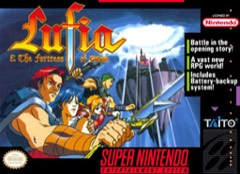
It starts at the end of someone else's adventure. Four heroes, Maxim, Selan, Artea and Guy, storm a floating castle and beat the four Sinistrals who live in it. As the castle falls, Maxim and Selan are cut off by a chasm and go down with it. Peace lasts ninety years, and the game proper begins nine years after that, with a red-haired descendant of Maxim you name yourself.
He grows up with a girl called Lufia who turns up one day in a field and asks to play. When the Sinistrals return, the two of them set out with Aguro, a soldier, and Jerin, a half-elf archer, to find what's left of the old party. Guy is too old and dies from the shock of the news. Artea, an elf, has lived through it all and hands his bow to Jerin.
The rest is classic early-nineties RPG: towns, shops, dungeons, random battles seen from the front, and experience that makes your party stronger. You save by talking to a priest. One old-fashioned quirk matters: if two characters attack the same enemy and the first one kills it, the second swings at nothing. You have to plan who hits what.
Where it sits in history
Neverland developed it and Taito published it, in Japan as Estpolis Denki in June 1993 and in North America that December. It began the Lufia series and is the only one Taito released in North America. In February 1994 it was the best-selling Super NES game in the United States, and GamePro made it runner-up for its 1993 role-playing game of the year, behind Secret of Mana.
Taito started a Mega Drive version for North America and advertised it in magazines, but it was never released after Taito America closed in 1995. A former programmer leaked it online in 2014. The English version also swaps two villains' titles: Daos and Amon each have the other's.
How it plays today
The opening still works. Playing as the old heroes for a few minutes, then watching them become history, gives the whole adventure a weight its battles never quite match.
Those battles are the weak part. The wasted attacks get old, the dungeons are harsh, and the fights blur together. If you've played Final Fantasy or Lufia II, this will feel like a draft. Come for the story, the characters and the ending.
Compared with
Why it matters
The game makes you live the legend before you inherit it. You hold the sword as Maxim, you lose him, and then you spend the rest of the game as someone who only knows him as a name. Artea is the thread between the two halves, an old friend still standing, and his bow passing to Jerin says more about time than any speech.
Wildschut and colleagues found nostalgia is mostly a warm feeling, usually built around people close to us, and that it leaves us feeling more connected. Lufia is built the same way. Its past is a group of friends, and the hero's job is to keep faith with them. At the end, Lufia comes back with no memory, and he chooses to help her start again.
Read: Why old games feel like home →
- Wildschut, T., Sedikides, C., Arndt, J., & Routledge, C. (2006). Nostalgia: Content, triggers, functions. Journal of Personality and Social Psychology, 91(5), 975-993. doi:10.1037/0022-3514.91.5.975
What you're levelling up
You have been training these without noticing. Here is how to do it on purpose, and where it pays off away from the couch. All the skills games teach →
Planning ahead
In the game. If two characters attack the same enemy and the first one kills it, the second swings at nothing. Every turn you plan who hits what.
Do it on purpose. For one dungeon, give each character a target before you hit confirm. Notice how many wasted swings you cut.
Off the couch. Splitting jobs before you start, not after, saves a whole Saturday of moving house. Same for group trips and work projects.
Story sense
In the game. You play the old heroes for a few minutes, then watch them become history ninety years later. That opening gives the whole adventure a weight its battles don't.
Do it on purpose. When you meet Artea or hear about Guy, stop and think about what it means to the new party, not just what it unlocks.
Off the couch. Knowing someone's backstory changes how you see them. Ask your nan, your mate, or a date where they come from, and listen properly.
Bouncing back
In the game. The dungeons are harsh and the random fights blur together. Plenty of players bail halfway.
Do it on purpose. Set a small target each session, one dungeon or one town, and stop there. Finishing beats grinding till you hate it.
Off the couch. Uni, a trade, a long savings goal. Small finish lines keep you going when the middle gets boring.
Verdict · 6/10
An ordinary RPG with an unusual opening and an ending that earns it. Better as a story than as a game.