What it was
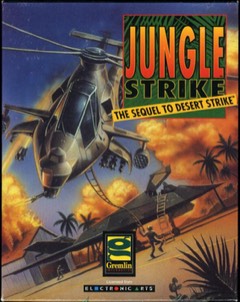
You fly a Comanche attack helicopter through a string of missions. Blow up the installations, rescue the hostages, capture the bad blokes. Two villains this time: Ibn Kilbaba, son of the first game's baddie, and Carlos Ortega, a drug lord out for revenge. It opens in Washington, D.C., with terrorists going after the President's limousine, and it ends back there with four trucks full of nuclear bombs rolling at the White House.
It looks down on the action from above with a slight 3D tilt. Here's the catch: you have three things draining at once. Armour goes when you're hit. Fuel burns as the mission drags on. Ammo runs out. Fuel barrels, ammo crates and rescued friendlies top them back up, so every mission is a bit of a shopping trip with rockets.
Your weapons are machine guns, Hydra rockets and Hellfire missiles, and the stronger the weapon, the fewer you can carry. Along the way you get to drive other rides: a motorbike, a hovercraft and an F-117, which flies at varying heights with unlimited ammo but is touchier about crashes.
Where it sits in history
It's the sequel to Desert Strike, which came out in 1992 and was Electronic Arts' best seller at the time. Jungle Strike landed on the Sega Genesis in 1993 as EA's first ever 16 megabit cartridge, with game director John Manley and associate producer Tony Barnes leading the sequel. The Super NES and MS-DOS versions came later from Gremlin Interactive, with an Amiga version by Ocean Software and handheld ports by Black Pearl Software.
The original engine came out of a flight simulator that didn't work, and the idea was inspired by Matchbox toys and Choplifter. Jungle Strike kept that core and added vehicles and locations.
Critics were warm on it. GamePro praised the SNES version for keeping the Genesis gameplay while improving the graphics and sound, and Total! put it 29th on their 1995 Top 100 SNES Games. Not everyone loved the politics: Amiga Power said you're battered with right-wing US politics throughout. They had a point.
How it plays today
It holds up because it's a puzzle disguised as a shooter. You can't just spray rockets and hope. You decide what to load, what to leave, and when to peel away to refuel before the next target. It's slower than a run-and-gun and more satisfying for it.
It does bite. Reviewers at the time called the early difficulty high, and the learning curve is real. The reward is the one the New Straits Times review nailed: once you've got the skills, it's hours of fun. If you like thinking in a cockpit, play it. If you want twitch, Axelay is down the road.
Compared with
- Axelay: Another SNES shooter, but this one is about flying fast and reading patterns. Jungle Strike is about managing what you're carrying.
- Choplifter: The helicopter-rescue game that inspired the Strike series.
- Cybernator: Another SNES shooter, a very different one: a mech in constant motion, with no supplies to juggle.
Why it matters
Jungle Strike gives you three meters and no way to fill them all. That's a small lesson in how people really get through a day: we run low on one thing while another is fine, and we pick which to top up first.
Juul's paradox of failure fits. We avoid failing in life and chase it in games, because each crash tells us what to do next time. Run out of fuel and you learn to scan for barrels earlier. The sting is where the learning comes from.
Read: One must imagine Mario happy →
- Juul, J. (2013). The Art of Failure: An Essay on the Pain of Playing Video Games. MIT Press.
What you're levelling up
You have been training these without noticing. Here is how to do it on purpose, and where it pays off away from the couch. All the skills games teach →
Planning ahead
In the game. Fuel, armour and ammo all drain at once, so you plan the route to the next barrel before you start the next target.
Do it on purpose. Before every mission, name the first thing you'll run short of and where you'll refill it.
Off the couch. Packing a ute, budgeting a fortnight, sorting the order of a Saturday's errands.
Judging risk
In the game. The stronger the weapon, the fewer you carry, so every Hellfire is a bet you won't need something else.
Do it on purpose. Go in with the heavy loadout for one mission and note what you wish you'd brought.
Off the couch. Deciding what to bring on a hike, how much to put on a deal, whether to take the shortcut.
Hand-eye coordination
In the game. You thread the Comanche between artillery and armoured cars while lining up shots from an angled overhead view.
Do it on purpose. Pick one tough target and clear it without taking a single hit, then try it with the F-117.
Off the couch. Driving in traffic, catching a falling glass, hitting the shot in backyard cricket.
Verdict · 8/10
A smart, tough helicopter game that turns shooting into logistics. Worth it if you like deciding what to carry.