What it was
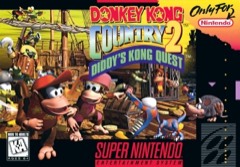
This time Donkey Kong is the one who needs rescuing. Kaptain K. Rool has kidnapped him and wants the banana hoard as ransom, so Diddy Kong and newcomer Dixie Kong sail to Crocodile Isle: eight worlds and 52 levels of pirate-flavoured trouble, from a skull-shaped roller coaster to honey-coated beehives, plus a hidden Lost World.
Dixie is the big addition. She can spin her ponytail like a helicopter blade to float down slowly, which changes how you approach every gap, while Diddy is quicker on his feet. Either Kong can pick up and throw the other. Animal friends return, now including Squitter the spider and Rattly the snake, who bounces to great heights. Hidden bonus games pay out Kremcoins, which open the Lost World.
Where it sits in history
Rare started it straight after the first game, before anyone knew how well that one would sell. Tim Stamper directed and Gregg Mayles led the design, and in response to veteran players who found the original too easy, they made it harder and less linear. Mayles, 23 at the time, poured his interest in pirates into the setting. David Wise wrote the score again, and his Stickerbush Symphony has become one of the most admired pieces of game music ever written.
Nintendo released it on 21 November 1995 in Japan, 4 December in North America and 14 December in Europe. Retailers struggled to keep it in stock; it sold 4.37 million copies across the US and Japan and was the second best-selling game of 1995, behind Yoshi's Island.
How it plays today
Superbly. The pre-rendered art is warmer and more detailed than the first game's, the levels have more ideas per stage, and the difficulty climbs to a genuinely demanding final stretch without feeling cheap. Checkpoint barrels are well placed, so dying costs you little.
The downsides are small. A few gimmick levels lean on memorisation. The hunt for every bonus game and DK coin is satisfying but asks a lot, and the 102 per cent completion score will take most people a guide. If you only play one Donkey Kong Country, this is the one.
Compared with
Why it matters
Play the opening of Stickerbush Symphony in a room of people who had a Super Nintendo and watch at least one of them go somewhere else for a moment. A bramble maze, a monkey with a ponytail, a bedroom in 1995.
Tim Wildschut and colleagues found nostalgia is mostly positive, often features close others, and raises connectedness and self-regard. Diddy's Kong Quest gives it plenty to work with. David Wise's score does not only recall the game; it recalls who you were when the game was hard and you had all afternoon. The design helps. Rare made it harder on purpose, for veterans who found the first game too easy, and the demanding final stretch is the kind of struggle people remember with pride. If nostalgia lifts self-regard, here you earned a little of it. That is a warm thing to carry: proof you once stuck at something difficult, with very good music playing.
Read: Why old games feel like home →
- Wildschut, T., Sedikides, C., Arndt, J., & Routledge, C. (2006). Nostalgia: Content, triggers, functions. Journal of Personality and Social Psychology, 91(5), 975-993. doi:10.1037/0022-3514.91.5.975
What you're levelling up
You have been training these without noticing. Here is how to do it on purpose, and where it pays off away from the couch. All the skills games teach →
Timing and rhythm
In the game. Dixie spins her ponytail to float slowly, which changes how you approach every gap. The difficulty climbs to a genuinely demanding final stretch.
Do it on purpose. Pick a gap that kills you and try it twenty times with Dixie's spin. Notice when the float becomes automatic.
Off the couch. Dancing, sport, knowing when to make your move. People with good timing look relaxed because they're not rushing.
Curiosity
In the game. Hidden bonus games pay out Kremcoins for the Lost World, and every level hides a DK coin.
Do it on purpose. Pick one level and refuse to leave until you've found every bonus. No guide.
Off the couch. Curious people find the good stuff, the back bar, the hidden track, the story behind someone's tattoo. And asking about it makes you good company.
Teamwork
In the game. Diddy is quicker, Dixie floats, and either Kong can pick up and throw the other.
Do it on purpose. Play a level swapping Kong at every obstacle based on who suits it best. Say why each time.
Off the couch. A relationship works the same: two different people, each better at different things. Use both.
Verdict · 10/10
Harder, prettier and more imaginative than its predecessor, with one of the SNES's finest soundtracks. A high point of 16-bit platforming.