What it was
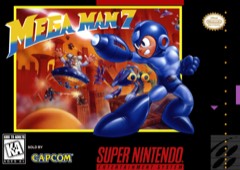
Six months after Mega Man 6 puts Dr. Wily behind bars, four Robot Masters he hid away wake up on a timer and break him out. Mega Man arrives to a city in ruins, meets a dark, sharp-tongued robot called Bass and his wolf Treble, and is told they are on his side. You can guess how long that lasts.
The play is the classic shape in 16-bit clothes: pick a stage, beat its boss, take its weapon. The twist is that only four stages, Freeze Man, Junk Man, Burst Man and Cloud Man, are open at first; the second four unlock once those fall. Defeated enemies drop bolts, and between stages you spend them at a shop run by Auto, Dr. Light's new green assistant. Rush can now dig for items wherever you stand, and the letters R, U, S and H hidden in the stages earn the Super Adaptor, a jetpack and rocket fist in one. The weapons also touch the world now: the team set out to give Master Weapons things to do in the stages beyond hitting enemies.
Where it sits in history
Capcom released Mega Man 7 in Japan on 24 March 1995, and in North America that September. It is the only numbered entry in the original series on the Super NES; the Mega Man X spin-off had arrived on the console more than a year before. Bad timing left the team about three months to finish it. Hayato Kaji took over as head illustrator from Keiji Inafune, who still designed Auto from the tin robots he remembered as a child and made the first rough sketches of Bass and Treble. The eight Robot Masters came from fan contests in Japan, which drew around 220,000 entries.
A week before beta, the team agreed to add a hidden two-player fighting mode, Mega Man against Bass, on condition it shipped without bugs. It was built in two days and locked behind a password. Capcom first said the finished English version would not be released, then changed course after players pushed back.
How it plays today
The bigger sprites and brighter colours are lovely, and Freeze Man's and Turbo Man's stages are good fun. Critics at the time called it the same game again and set it beside Mega Man X, which had pushed the series forward on the same machine a year earlier. That comparison still holds.
Where it earns its place is the ending. The final fight is meant to be brutal, and the team said so, and the scene afterwards, with Mega Man standing over Wily, is the most interesting moment the classic series ever wrote. The shop also makes this a kinder game than it looks: grind a few bolts and buy your way past a wall.
Compared with
- Mega Man 6: The NES game this follows directly, six months earlier in the story.
- Mega Man X: The same console's more inventive Mega Man, out more than a year before and the measure critics used.
- Mega Man & Bass: Bass gets his own game on the Super Famicom, the rival who wants to prove he is the stronger robot.
Why it matters
The team built the last boss to be something you could not beat without an Energy Tank. Which means the game plans for you to fail first. You walk in, lose, and go back to stock up, and that loss is the lesson rather than the end. Juul calls this the paradox of failure: we steer around failing in our lives, yet seek it out in games, because failure there makes us stop, rethink, and come back better.
There is something kind in a game that knows you will fall and leaves a shop open for when you do. It treats losing as part of the path, which is how most of the good things people learn get learned.
Read: One must imagine Mario happy →
- Juul, J. (2013). The Art of Failure: An Essay on the Pain of Playing Video Games. MIT Press.
What you're levelling up
You have been training these without noticing. Here is how to do it on purpose, and where it pays off away from the couch. All the skills games teach →
Planning ahead
In the game. Only four stages are open at first, and bolts from enemies buy upgrades at Auto's shop between stages. What you buy shapes the rest of the run.
Do it on purpose. Before you spend bolts, decide which stage you're doing next and buy for that. See if it goes smoother.
Off the couch. Budgeting is the same: decide where you're heading, then spend for that. Not on whatever's shiny at the counter.
Bouncing back
In the game. The final fight is meant to be brutal, and the team said so. You'll lose it more than once.
Do it on purpose. After each loss, grind a few bolts and buy one thing that fixes your worst moment. Then go again.
Off the couch. When something knocks you back, fix one specific thing before the next go. That's how you get the job on the third try.
Story sense
In the game. After the last fight Mega Man raises his buster at a begging Wily. In English he says he is more than a robot; in Japanese he just stands there in silence.
Do it on purpose. When you reach the ending, stop and ask what Mega Man should do, and why. Then watch what he does.
Off the couch. Being able to talk about a story, a film, a hard choice, and what you'd do, makes for a great second date conversation.
Verdict · 7/10
A handsome, rushed, warm-hearted Mega Man that plays it safe everywhere except its last scene. Worth it for Bass and the bolts shop.