What it was
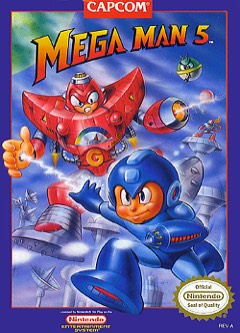
Mega Man 5 opens with a betrayal. Proto Man, Mega Man's older brother, seems to lead a robot army against the world and carries off Dr. Light. Mega Man fights through eight new Robot Masters, from Gravity Man to Wave Man, takes their weapons in the usual way, then storms Proto Man's fortress to find the truth. You can guess who is behind it. The game knows you can guess, and has fun anyway.
Under the story it is Mega Man as you know it: run, jump, shoot, pick your stage order, borrow each boss's power. The charged Mega Buster from Mega Man 4 now fires a wider blast, though a hit before release throws the charge away. The stages take more liberties than before. Gravity Man's level flips you onto the ceiling, and halfway through Wave Man's you ride a water craft to the boss door. Hidden in each stage is a letter plate; collect all eight to spell MEGAMANV and you earn Beat, a little robot bird who darts at anything on screen.
Where it sits in history
Capcom released Mega Man 5 in Japan on 4 December 1992 and in North America the same month; Nintendo published it in Europe the next year. Keiji Inafune, credited as Inafking, worked under a new project leader and steered the team away from what he called an unreasonable game, an affront to players. He believed the result came out easier than the earlier entries. The team felt Mega Man 4 had used up their gameplay ideas, so the plan here was to power up what already existed. Hayato Kaji, who had come up with the chargeable Buster, joined midway through to help a game that was taking a while to come together.
The bosses came from the players. Capcom ran a contest with Nintendo Power and received more than 130,000 character designs; the eight Robot Masters in the game grew out of those entries. Inafune had to redraw them several times to get them approved. Beat sailed through on his first draft, an idea left over from Mega Man 3, when the team kept the dog, Rush, and set the bird aside. Mari Yamaguchi wrote the music.
How it plays today
Inafune was right: this is the easiest of the NES six to sit down and finish, and that is not a fault. The wider charge shot does a lot of the work, Beat cleans up the screen, and the bosses rarely punish you the way Mega Man 2's can. If you have bounced off the series before, start here.
What it lacks is surprise. Critics at the time called it a repeat, and there is truth in that: the shape of the game is Mega Man 4 again with a few new toys. But the gravity stage still feels clever, Napalm Man and Charge Man are good fights, and the twist with Proto Man gives the ending a little warmth. It is comfort food from a kitchen that knew exactly what it was doing.
Compared with
- Mega Man 4: The game this one builds on; harder, with the charge shot in its first, narrower form.
- Mega Man 6: The next entry, with branching stages and Rush armour; a little richer, a little sillier.
- Mega Man X: Made alongside the last NES games and released in 1993, it shows where the series went next on the Super NES.
Why it matters
Somewhere in 1992 a kid sat at a kitchen table drawing a robot, posted it to a magazine, and later found that robot waiting at the end of a stage. More than 130,000 people sent drawings. Winnicott described play as the space between the inner world and the outer one, where people are creative and find something of themselves. A design contest stretches that space across an ocean: a private doodle becomes a boss millions of strangers fight.
That is a generous way to make a game. It says the people who love a thing can help make it, and it turns a cartridge into a small shared project between a studio and children it would never meet.
Read: Who you are when you play →
- Winnicott, D. W. (1971). Playing and Reality.
What you're levelling up
You have been training these without noticing. Here is how to do it on purpose, and where it pays off away from the couch. All the skills games teach →
Spatial thinking
In the game. Gravity Man's stage flips you onto the ceiling. Suddenly up is down and every jump needs rethinking.
Do it on purpose. Play Gravity Man's level and, before each flip, call where you'll land. Count how many you got right by the end.
Off the couch. Flipping a problem upside down, seeing it from the other side, works on flat-pack furniture and on an argument with a mate.
Curiosity
In the game. A letter plate hides in each stage. Collect all eight to spell MEGAMANV and you earn Beat, the little robot bird.
Do it on purpose. Replay one stage purely to find its letter. Look high, look low, check the dead ends.
Off the couch. The small extra effort, the detour, the odd question, is often where the good stuff hides. Same in a new suburb or a new job.
Bouncing back
In the game. The charge shot is wider here, but take a hit before you let go and the charge is gone. Even the gentlest NES Mega Man takes a few goes per boss.
Do it on purpose. If you've bounced off Mega Man before, set yourself one boss per session. Finish this one and build from there.
Off the couch. Confidence comes from small wins stacked up. Start with something you can finish, then go harder. It shows, at the gym and on a date.
Verdict · 7/10
A confident, gentle Mega Man that powers up everything rather than reinventing anything. The best first Mega Man for a nervous player.