What it was
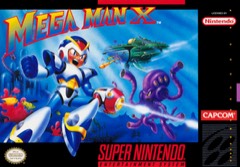
A century after the NES games, a scientist digs up X, Dr. Light's last robot, and copies him to make Reploids, machines that think and choose. Some choose badly and become Mavericks. The Maverick Hunters exist to stop them, until their leader Sigma turns and takes most of the Hunters with him. X and his partner Zero are what is left.
The structure is classic Mega Man: an opening stage, then eight bosses in any order, each giving you a weapon another boss hates. What changed is how X moves. He clings to and leaps off nearly any wall, dashes once you find the leg upgrade, and collects armour parts, Heart Tanks and Sub-Tanks hidden around the stages. Some stages even change when you beat another boss first; clearing Storm Eagle's aircraft carrier knocks out power in Spark Mandrill's plant.
Where it sits in history
Capcom's NES Mega Man team made it, with Keiji Inafune and Hayato Kaji swapping their usual roles: Kaji drew X, Inafune designed Zero. Inafune wanted Zero as the hero, but fearing fans' reaction, the team kept him in support. The bosses dropped the old 'Man' names for animal-shaped robots, and the story took a harder edge, with a villain you are not meant to like. Setsuo Yamamoto wrote most of the music with help from four other Capcom composers.
It reached Japan in December 1993 and North America early in 1994, sold more than a million copies on the SNES, and started a series of its own, with seven direct sequels. Zero proved popular enough to get his own spin-off series on the Game Boy Advance.
How it plays today
It feels terrific. The dash and wall jump make X quicker and more acrobatic than any NES Mega Man, and the stages are built around both. Hunting for upgrades rewards replaying stages with new weapons, and the order you beat bosses in matters in fun ways. Sprites are big and crisp, and the music drives every stage along.
It is also easier and shorter than the NES games, which some critics complained about at the time. Sub-Tanks and a forgiving checkpoint system mean most players will see the end, and experienced players may find the challenge thin. The story is more grown-up than before but still slight. For most people, that accessibility is a plus: it is the best place to start with Mega Man.
Compared with
- Mega Man 3: The NES game that added the slide; X turns that idea into a full dash and adds wall jumps.
- Mega Man X2: The 1994 sequel keeps the formula; play the first for the story's setup and the cleaner learning curve.
- Super Metroid: Both are SNES action games about finding upgrades that open new routes; Metroid is a maze, X a set of stages.
Why it matters
X clings to nearly any wall and leaps off it, finds the dash, and suddenly the stages make sense at speed. Mega Man X is one of the SNES's cleanest routes into flow. Mihaly Csikszentmihalyi described flow as absorption that comes when challenge matches skill, the goals are clear and feedback is immediate; self-consciousness drops away and time distorts. Run, jump, climb, dash, and the next move is always just becoming possible.
Critics at the time complained X was easier than the NES games. That misses what the balance buys. Sub-Tanks and forgiving checkpoints keep more players in the band where challenge meets skill, instead of bouncing them off it. Ryan, Rigby and Przybylski found that feeling competent is one of the needs games satisfy, and that it predicts wanting to play again. Being good at something, and feeling it in your hands, is one of the plainest pleasures people have. Mega Man X hands it to nearly everyone who picks it up. That is generous, not soft.
Read: The zone: why good games make time disappear →
- Csikszentmihalyi, M. (1990). Flow: The Psychology of Optimal Experience.
- Ryan, R. M., Rigby, C. S., & Przybylski, A. (2006). The motivational pull of video games: A self-determination theory approach. Motivation and Emotion, 30(4), 344-360. doi:10.1007/s11031-006-9051-8
What you're levelling up
You have been training these without noticing. Here is how to do it on purpose, and where it pays off away from the couch. All the skills games teach →
Systems thinking
In the game. Clearing Storm Eagle's aircraft carrier knocks out power in Spark Mandrill's plant. The order you beat bosses in changes the stages.
Do it on purpose. Play with a different boss order and note one stage that changed because of it.
Off the couch. In a workplace or a family, one move ripples into another. Seeing that before you act is how you avoid a mess.
Curiosity
In the game. Armour parts, Heart Tanks and Sub-Tanks hide around the stages, and some need a weapon you get later.
Do it on purpose. Replay a cleared stage with every weapon you've got and hunt one upgrade you skipped.
Off the couch. Going back to something with fresh eyes, an old hobby, an old mate, often turns up more than you expect.
Hand-eye coordination
In the game. X clings to and leaps off nearly any wall and dashes once you find the leg upgrade. The stages are built around both.
Do it on purpose. Find a tall wall section and climb it with wall jumps only, no stops. Time yourself and try to beat it.
Off the couch. Being good at physical stuff, climbing, kicking a ball, dancing, is quietly attractive. Confidence in your body shows.
Verdict · 9/10
The best 16-bit reinvention of an 8-bit hero, and one of the SNES's finest action games. Easier than its ancestors and all the better for newcomers.