What it was
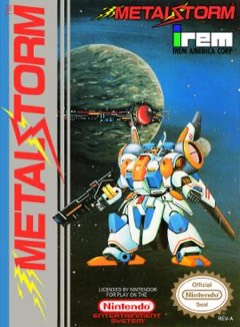
You're the M-308 Gunner, a combat mech sent to Pluto in the year 2501 to switch off a defence cannon that has gone rogue and started blowing up planets. Neptune is the latest. The trick is the controls: press Up and Jump together and you flip between floor and ceiling. Other games of the time, Mega Man 5 and Strider among them, give you a gravity-flip section. Metal Storm builds the whole game on it.
That shapes everything. Corridors are puzzles in which surface you stand on. Lasers and crushing blocks switch on and off depending on your orientation, and later stages wrap you from one side of the screen to the other. There are six stages of two acts each, then a seventh that is a boss rush. You carry one power-up at a time: a Power Beam, a Shield or a Gravity Fireball that makes you invincible mid-flip. With so little firepower, movement does the work.
Where it sits in history
Tamtex, a Tokyo subsidiary of arcade giant Irem, made it. Irem leaned on Tamtex for Famicom and NES work, and the game shows the arcade side: steep but fair, pattern-driven, the sort of difficulty you'd expect from the studio behind R-Type. It also looks better than it should. The programmers faked parallax scrolling with a custom mapper chip and bank switching, giving two background layers moving independently, something almost no other NES game pulled off.
North America got it in February 1991. Japan got it on 24 April 1992, more than a year later, as a more finished version with a full intro, extra dialogue and a different colour palette for the mech. Nintendo Power put it on the cover of the March 1991 issue with a 12-page guide, and it still flopped. Timing hurt it: a new property on a console on its way out, with the Super Nintendo about to land. Reviews were good. Computer and Video Games gave it 88/100, Mean Machines 88%. Nintendo Power later filed it under Unsung Heroes of the NES, and IGN ranks it 46th best on the system.
How it plays today
It's tough, and it's short, which 1UP noted when it called it a hidden gem. The flip feels great once it clicks: you start reading a room as two rooms, floor and ceiling, and picking the safer one. The music is the weak spot. Critics call it forgettable, and the flip sound is the better noise in the game.
Finish it and you unlock Expert Mode, a rebuilt version with most power-ups removed, new boss patterns and every hazard moved. Unlimited continues let you grind it, but Jeremy Parish compared it to a Kaizo hack. That's for people who like to suffer.
Compared with
- Mega Man 5: Has a gravity-flip stage, but only as a stage. Metal Storm makes it the whole game.
- Strider: Another action game of the era with a stretch of reversed gravity.
- Mega Man 2: The benchmark for tough, tight NES action, and a good game to play next.
Why it matters
Metal Storm takes away the one thing platformers never question: which way is down. Juul writes that we dodge failure in life but go looking for it in games, because failing makes us rethink and get better. A room that kills you until you see it upside down is that idea in practice.
And it was a flop that people kept coming back to. The game that nobody bought in 1991 got championed in 1993, rediscovered online and put back on a cartridge in 2019. Some things are worth finding late.
Read: Wanting, not liking: what dopamine really does when you play →
- Juul, J. (2013). The Art of Failure: An Essay on the Pain of Playing Video Games. MIT Press.
What you're levelling up
You have been training these without noticing. Here is how to do it on purpose, and where it pays off away from the couch. All the skills games teach →
Spatial thinking
In the game. Every corridor can be crossed from the floor or the ceiling, and lasers and crushing blocks change with which one you pick.
Do it on purpose. Before each room, say whether floor or ceiling is safer, then check. Do ten rooms.
Off the couch. Reading a floor plan, reversing a trailer, seeing how furniture fits before you lift it.
Pattern recognition
In the game. Boss attacks and hazard timings repeat. Learn the cycle and the fight shrinks to a few moves.
Do it on purpose. Fight one boss with no shooting for the first minute. Just watch the pattern.
Off the couch. Spotting the same excuse, the same traffic jam or the same weak spot in a pitch before it bites.
Bouncing back
In the game. Expert Mode strips the power-ups and moves everything. You'll die a lot, and unlimited continues are there so you retry straight away.
Do it on purpose. Pick a single room in Expert Mode and stay on it until you clear it, without quitting out.
Off the couch. A knockback at work, a bad night out, a flat tyre. You get up and have another go.
Verdict · 8/10
A clever, hard, good-looking NES oddity that deserved a bigger audience than it got. Play the 2019 re-release if you can find it.