What it was
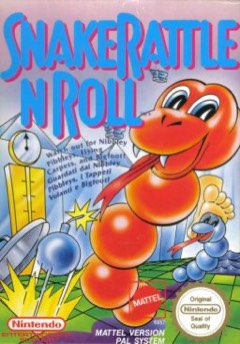
Two snakes, Rattle and Roll, climb through eleven isometric levels. Each level ends at a weighing machine with a bell on top, and you can only ring it once your snake is heavy enough. So you eat. Nibbley Pibbleys, small round creatures, bounce out of dispensers and hide under manhole lids, and you snap them up with your tongue. Your own colour makes you grow faster; yellow ones most of all. When your tail flashes, you are heavy enough to go.
Everything else wants to stop you. Enemies take a segment off your body with each hit, spikes and long falls kill you outright, objects drop on your head, and if you swim too long a shark comes for you to two notes you will recognise. Dispensers also spit out bombs. Two players can play at once, one snake each, sharing the same screen.
Where it sits in history
Rare built it for Nintendo, mainly through two people: Tim Stamper on graphics and ideas, Mark Betteridge on the program. Betteridge had set himself a challenge to make the smallest NES game he could, and found a way to draw cheap backgrounds that took up little memory. Working out what could move across those backgrounds led him to a snake. Much of it grew out of Rare's NES port of Marble Madness, including its fast scrolling. Gregg Mayles, later Rare's creative director, started at the company playtesting it.
David Wise wrote the music as twelve-bar early rock 'n' roll, after the 1954 song the title plays on. It came out in North America in July 1990 and in Europe in March 1991. Nintendo Power later named it among the NES games that were overlooked and sold poorly, blaming heroes nobody recognised. A Mega Drive port, Europe only, added a twelfth level: the snakes head for space, a meteorite knocks them down, and they crash land on a strange little planet.
How it plays today
Like nothing else on the NES. The levels are full of jokes, odd objects and secret lids, the music bounces, and the snakes feel quick and precise on the pad.
The isometric view is also the problem. Judging depth on a diagonal grid is hard, jumps you think you have made drop you off the edge, and the difficulty climbs steeply. Two players at once makes it louder and better.
Compared with
- Marble Madness: The isometric game Rare ported to the NES first, and the root of this one.
- R.C. Pro-Am: An earlier Rare NES game that one German magazine compared it to.
- Q*bert: Another hop across a diagonal grid; Nintendo Power's preview named it as a reference.
- Adventures of Lolo: The same preview said players who liked Lolo would like this.
Why it matters
Erving Goffman wrote that a game builds a shared world with its own rules about what matters, and that being absorbed in it together is what makes an encounter feel alive. Two people on a couch, each steering a snake, arguing over a yellow Pibbley: for a few minutes nothing outside those eleven levels counts.
And Nintendo Power's reason for its poor sales says something too. Nobody knew who Rattle and Roll were. A familiar face sells; an odd one waits, which is why so many good ones are found later, second-hand, by someone curious.
Read: The second controller →
- Goffman, E. (1961). Encounters: Two Studies in the Sociology of Interaction ('Fun in Games').
What you're levelling up
You have been training these without noticing. Here is how to do it on purpose, and where it pays off away from the couch. All the skills games teach →
Spatial thinking
In the game. Judging depth on a diagonal isometric grid is hard, and jumps you think you've made drop you off the edge. It's a proper workout for your sense of space.
Do it on purpose. Before every jump, stop, line the snake up with the tile you're aiming for, and only leap when you know where it lands.
Off the couch. Parking, packing the car, figuring out if that couch will fit through the door. Good spatial sense saves heaps of hassle.
Bouncing back
In the game. Spikes and long falls kill you outright, and the difficulty climbs steeply. You'll fall off a lot.
Do it on purpose. Count your deaths on one level. Next run, change how you approach the spot that killed you most.
Off the couch. Falling on your face at something new, a sport, a job, chatting to someone, and trying again is how anyone gets good.
Teamwork
In the game. Two players at once, one snake each, on the same screen, both after the same Nibbley Pibbleys. Louder and better together.
Do it on purpose. With a mate, agree who eats which colour so you both get heavy enough to ring the bell. See if you finish faster.
Off the couch. Sharing a goal without fighting over the same resources is how housemates, workmates and couples actually get along.
Verdict · 7/10
A bright, odd, ambitious Rare game that never found its audience. Hard and sometimes unfair, but no other NES game feels like it.