What it was
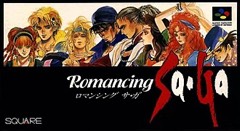
An RPG that hands you the map and walks away. You pick one of eight heroes (a noble heir, a pirate, a thief, a warrior from the snow, a travelling performer and more), and the world of Mardias is yours to wander in whatever order you like. The story moves on how many events you've triggered, how strong you are and who you've spoken to, not on a chapter counter. The designers called it the Free Scenario System.
Battles are odd on purpose. Your party stands in a formation on a 3x3 grid, and where you stand changes who can hit what. There are no experience points. Stats creep up at random depending on what you did in the fight, and weapon skills unlock by using the weapon enough times. A fallen party member returns to low health after the battle, but if everyone drops, it's over.
Where it sits in history
Production began in 1990, when Nintendo asked Square for a new SaGa for the Super Famicom after the Game Boy games did well. Akitoshi Kawazu directed, designed and wrote it. The Free Scenario System was built as a direct contrast to the straight line of Final Fantasy. Eight heroes came partly from taiga dramas and partly from a Japanese novel about eight warriors, and partly because Kawazu wanted the formation system. Writing one central plot plus eight personal ones was hard going, and Nintendo's cartridge size limits forced several planned ideas out. Tomomi Kobayashi drew the characters, her first game work, and Kenji Ito wrote all the music.
It came out on 28 January 1992, the second Square game on the system after Final Fantasy IV. It topped the Famitsu sales charts from February to March, and by 2004 had sold over 1.3 million copies worldwide. It never got an official English release. The sheer amount of text, and a complexity that might put people off, are the usual reasons given. An English fan translation patch arrived in 2015.
How it plays today
Famitsu's four reviewers marked the graphics down against Final Fantasy but loved the freedom. That's still the fair summary. Vice's 2017 retrospective admired how open-ended it was next to other games of its day, then faulted the execution and the confusing battle mechanics. Come in expecting to be lost for the first hour, and to like it.
If that sounds like too much, the 2005 PlayStation 2 remake, Romancing SaGa: Minstrel Song, was built to be friendlier, with tutorials and changes so you can see all eight stories. A remaster of it came out worldwide in 2022 on Android, iOS, Switch, PS4, PS5 and Windows.
Compared with
- Romancing SaGa 2: The 1993 Super Famicom sequel, in the same family of free-form RPGs.
- Romancing SaGa 3: The 1995 follow-up that finished the Super Famicom trilogy.
- Final Fantasy IV: Square's other big Super Famicom RPG of the time, and the straight-line story this one was built to push against.
Why it matters
Most games ask who you want to be once, at the start, and then run the same story. This one makes the choice the whole point. Eight people, eight stories, one world, and nobody is the real hero until you pick them. Games researcher James Paul Gee describes the player's identity in a game as a blend of the real self and the character, shaped by what the player wants that character to be.
That's why picking Hawk the pirate over Albert the heir feels like a statement. You're not choosing a class, you're choosing who you'd rather be for forty hours. And once you've seen the others stand around as recruits in your party, you start wondering what their stories were.
Read: Who you are when you play →
- Gee, J. P. (2003). What Video Games Have to Teach Us About Learning and Literacy.
What you're levelling up
You have been training these without noticing. Here is how to do it on purpose, and where it pays off away from the couch. All the skills games teach →
Curiosity
In the game. The Free Scenario System has no fixed route. Events trigger as you wander, talk to people and poke at corners of Mardias.
Do it on purpose. Skip the obvious next town for one session and go wherever looks odd. Note what you found.
Off the couch. Same itch gets you the better job lead, the side street with the good pub and the mate who knows someone.
Planning ahead
In the game. Formations on a 3x3 grid change who can be hit and from where, so your line-up is a decision before a fight starts.
Do it on purpose. Before each battle, set your formation, then say what you expect the enemy to hit first. Check after.
Off the couch. Setting things up before the pressure arrives is what separates the person who has it handled from the one scrambling.
Systems thinking
In the game. No experience points. Stats rise from what you do in battle, and weapon skills unlock through use, so every habit shapes your party.
Do it on purpose. Pick one character and use only one weapon for a whole dungeon. See what it did to them.
Off the couch. What you repeat is what you become, at the gym, at work and in a relationship.
Verdict · 7/10
A brave, rough RPG that chose freedom over hand-holding and never quite landed it. Play the remaster for a gentler way in, the original for the history.