What it was
You are a teenage boy in Kichijōji, Tokyo, in the year 199X, living with your mum and your dog. An email arrives with a program attached that lets you talk to demons. A scientist has opened a portal, demons are loose, and the US military and the Japan Self-Defense Forces are squaring off over what to do about it. It ends with missiles on Tokyo. You are thrown thirty years forward into the ruins, where two cults fight over what comes next: the Order of Messiah, building towards a Thousand-Year Kingdom, and the Ring of Gaea, who want to summon Lucifer and set everyone free.
It is a first-person dungeon crawler with turn-based fights, but the heart of it is talking. Instead of killing a demon you can ask it for money or items, try to send it away, or talk it into joining you. Demons never earn experience, so the only way to make them stronger is to fuse two or three at a Cathedral of Shadows. Summoned allies burn a fuel called Magnetite as you walk, and they start taking damage when it runs out. Over everything sits alignment, Law to Chaos and Light to Dark, which shifts with your choices and decides which demons will deal with you, which doors open and which ending you reach.
Where it sits in history
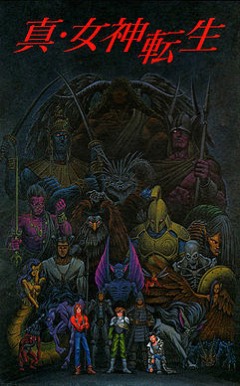
Atlus developed and published it, and it came out on the Super Famicom in Japan on 30 October 1992. The first two Megami Tensei games had come through Namco as spin-offs of Aya Nishitani's Digital Devil Story novels. When the novels' publisher never trademarked the name, Atlus did, got Nishitani's blessing, and treated this as a remake of Megami Tensei II with its own brand on the box. Kazuma Kaneko designed the characters and demons, drawing on woodblock prints, Micronesian masks and Ezekiel's many-headed angels. Tsukasa Masuko wrote the music while learning the Super Famicom's hardware as he went.
It was a big success that helped establish Atlus as a developer and publisher, and all four Famitsu reviewers gave it 9 out of 10. Its religious content likely kept it from the West; English speakers waited 22 years, until an iOS release in 2014, and that version stopped working with iOS 11 in 2017. It came back on the Wii and Wii U Virtual Console in Japan, and on Nintendo Classics in 2020. Toby Fox has named its dialogue system as an inspiration for Undertale.
How it plays today
More than thirty years on, it still feels dangerous. The demon art is wonderful, and the setting, a real Tokyo you walk from your home in Kichijōji to the ruins, has a punk edge most fantasy RPGs never touch. The negotiations are the reason to play: every random fight is a chance to strike a deal, or watch one go badly. Fusing two weaklings into something that wins you the next boss never gets old.
It is also hard work. The encounter rate is high, the corridors look alike, and the game tells you almost nothing about where to go or how its systems work. Even its makers felt fusion was too hard to master and the opening too abrupt. The Super Famicom original is Japanese only, so this is a commitment. Bring a notebook, graph paper and plenty of patience.
Compared with
Why it matters
Roger Caillois, the French writer on play, described a range running from paidia, free and unruly play, to ludus, play bound by rules. Shin Megami Tensei turns that range into its moral map. Law promises a logical order at the cost of feeling and freedom. Chaos promises unlimited freedom and leaves the weak behind. Every choice you make nudges you along that line, and the world answers: demons who won't deal with you, churches that won't let you in.
It lands because every game, and most lives, sit somewhere on that line. Too many rules and the joy drains out. No rules and nobody is safe enough to play. The neutral ending says it out loud: happiness needs balance, and the future should rest on people, not gods or demons. After a game that drops missiles on Tokyo, that is a surprisingly hopeful last word. The rebuilding is ours to do, together.
Read: The magic circle: the world that rules make →
- Caillois, R. (1958/1961). Man, Play and Games (trans. M. Barash).
What you're levelling up
You have been training these without noticing. Here is how to do it on purpose, and where it pays off away from the couch. All the skills games teach →
Reading people
In the game. Any demon can be talked to instead of fought. Ask for money or items, send it packing, or talk it into joining, and law-aligned demons won't team up with a chaos-aligned player.
Do it on purpose. Keep a tally of each demon type: what you asked, how it reacted. By the second dungeon you'll know who to charm and who to fight.
Off the couch. Reading the table on a date: are they lit up about the topic or just being polite? Notice, adjust, ask about what they love. That's not a tactic, it's paying attention.
Systems thinking
In the game. Demons never earn experience, so fusing two or three at a Cathedral of Shadows is the only way up. Meanwhile summoned demons burn Magnetite with every step, and your alignment shifts with every choice.
Do it on purpose. Before each fusion, write down what goes in and what comes out. After five, try to name the rule.
Off the couch. Money works like Magnetite. Every subscription you keep summoned, and the gym you never visit, drains you while you walk around. Audit the party.
Picking up a language
In the game. The Super Famicom original never left Japan. The only official English version arrived on iOS 22 years later, and it stopped running with iOS 11.
Do it on purpose. Learn the kana for the battle menu first. Then sound out demon names: Rushifā is Lucifer, and most of the cast are myths written in katakana, so they're easy wins.
Off the couch. Katakana alone gets you through half a Tokyo menu. Pointing at a dish and saying its name right beats pointing and hoping.
Verdict · 8/10
A bleak, brave RPG that made Atlus and still feels like a dare. The grind and the vague directions wear thin, but talking a demon onto your team is a thrill that holds up.