What it was
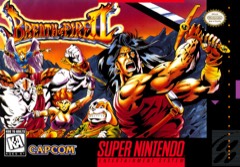
Five centuries after the first Breath of Fire, a boy named Ryu Bateson comes home to find his father and sister gone and his whole village unable to remember him. Ten years on, when his friend Bow is framed for a crime, Ryu sets out to clear his name, and the road leads into a much larger story. It is a direct sequel, which later games in the series are not.
Underneath is a traditional turn-based RPG with random battles, experience and a party of four. Capcom layered on some smart ideas. Each companion has a field skill that opens paths, breaks objects or dodges traps. A Formation system lets you arrange the party for speed, defence or attack. A meter warns how likely a fight is. Best of all, you can build a town, recruiting characters you meet to live there and paying carpenters for houses, and six elemental Shamans can move in and fuse with your fighters to change their forms and powers.
Where it sits in history
Capcom's first Breath of Fire team returned, including producer Tokuro Fujiwara and lead designer Yoshinori Kawano. Tatsuya Yoshikawa designed the whole cast, and newcomer Yuko Takehara wrote the entire score. Where Square had published the first game in North America, Capcom USA handled this one itself.
It reached Japan on 2 December 1994, the same week as Sony's PlayStation, and sold 350,000 copies there by the end of 1995. North America got it a year later, in December 1995, and it was the first Breath of Fire released in Europe, in April 1996 through Laguna. A Game Boy Advance port followed in 2002 with redrawn portraits, a dash button and save-anywhere.
How it plays today
The good parts are still good. The sprites are expressive, the world is large, and the town-building side project gives you a reason to poke into every corner. Shaman fusions add a layer of experimentation most SNES RPGs lack, and a story that opens with a village forgetting a child exists has an unsettling streak worth following.
The problems are just as real. The English translation is rough, with clumsy lines and missing spaces that make some dialogue hard to follow. Random battles come thick and fast. The pace drags in the middle, with a lot of errands between the good story beats, and it is easy to lose track of where to go. If you can live with grinding and the odd guide check, there is a lot to like; if not, it will test your patience.
Compared with
- Breath of Fire: The first game, which this one follows directly; the sequel is larger and deeper in its systems.
- Chrono Trigger: Released in the same era, faster, better translated and far easier to recommend; Breath of Fire II is for players who want more.
- Final Fantasy VI: The SNES RPG standard of the time; Breath of Fire II has fewer big moments but more side systems to tinker with.
Why it matters
Breath of Fire II opens on a child's worst fear: coming home to find nobody remembers you. Ryu's father and sister are gone and the village looks straight through him. Much of what follows answers that. Ryu crosses the world, meets people, and invites some of them to live in a town you build house by house. By the end there is a home again, made of people met along the way.
Tim Wildschut and colleagues found nostalgia is mostly positive, often features close others, and raises social connectedness and self-regard. That is the town, really: a place built out of other people that makes you feel a little more yourself. It suits a game people come back to years later, rough translation and all. The random battles still come thick and fast, but the idea underneath is warm. Being forgotten is the horror. A full town is the fix.
Read: Why old games feel like home →
- Wildschut, T., Sedikides, C., Arndt, J., & Routledge, C. (2006). Nostalgia: Content, triggers, functions. Journal of Personality and Social Psychology, 91(5), 975-993. doi:10.1037/0022-3514.91.5.975
What you're levelling up
You have been training these without noticing. Here is how to do it on purpose, and where it pays off away from the couch. All the skills games teach →
Systems thinking
In the game. Recruit characters to your town, pay carpenters for houses, and let six Shamans move in to fuse with your fighters. What you build at home changes what your party can do in the field.
Do it on purpose. Try one Shaman fusion you'd normally skip and track how it changes a fight. Note one knock-on you didn't expect.
Off the couch. How your money, your mates and your time feed each other is a system. Change one thing on purpose and watch the rest move.
Story sense
In the game. A story that opens with a village forgetting a child exists has an unsettling streak. The rough translation means you've got to read for what characters mean, not just what they say.
Do it on purpose. When a line comes out garbled, pause and work out what the character actually wanted. Say it in your own words.
Off the couch. People rarely say exactly what they mean, especially when they're upset. Hearing the thing under the thing makes you a better partner and mate.
Curiosity
In the game. The town-building side project gives you a reason to poke into every corner, because anyone you meet might move in.
Do it on purpose. In each new town, talk to everyone before you leave. Keep a list of who could be recruited.
Off the couch. Ask people about themselves and actually listen. You'll be amazed who you meet, and they'll notice you asked.
Verdict · 7/10
An ambitious, likeable RPG held back by its translation and pacing. Worth it for genre fans who have played the SNES's best and want more.