What it was
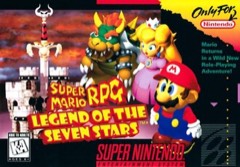
Mario rescues Peach from Bowser's castle in the first few minutes, and then a giant sword falls from the sky, lands in the keep and ruins everyone's plans. That is the joke Super Mario RPG opens on, and the tone holds: a Mario adventure told as a role-playing game, with the mushroom kingdom, a cloud boy who thinks he's a tadpole, and a wooden doll possessed by a star spirit.
The party grows to five, Mario plus Mallow, Geno, Bowser and Peach, with three in any fight. Battles are turn-based, but each attack, spell or block rewards a well-timed button press with extra damage or less harm taken. Outside battles the game plays like an isometric platformer. Mario jumps, hits floating blocks and hunts hidden chests, and enemies wander the map in plain sight, so you can often avoid a fight you don't want.
Where it sits in history
It came from two wishes meeting. Shigeru Miyamoto wanted to make a role-playing game with Mario, and Square wanted one that would sell outside Japan. Work began in early 1994, with Miyamoto producing, Chihiro Fujioka and Yoshihiko Maekawa directing and Yoko Shimomura writing a score that also arranges Koji Kondo's Mario themes and a few Final Fantasy IV tracks by Nobuo Uematsu. The team dropped weapons from the design because they didn't suit Mario, keeping only the hammer at Miyamoto's insistence. It runs on the SA-1 enhancement chip, one of only seven SNES games outside Japan to do so.
Released in Japan on 9 March 1996 and North America that May, it sold 1.47 million copies in Japan and was America's most-rented game for 14 weeks straight. Europe and Australia first got it on the Wii Virtual Console in 2008. Its timed hits and shared flower points carried into Paper Mario and the Mario & Luigi series, and ArtePiazza remade it for Nintendo Switch in 2023.
How it plays today
It is a light, funny, generous game. The timed hits keep every fight from turning into menu work, the writing has real wit, and the pre-rendered 3D look was striking for the SNES and still has a lot of charm. The platforming asides and minigames break up the adventure nicely.
It is also easy, especially for anyone who has played a role-playing game before, and fairly short. The isometric view makes a few jumps harder to judge than they should be. Neither matters much; it is meant as a friendly way in, and it does that job better than most.
Compared with
- EarthBound: Both play the role-playing game for laughs; EarthBound has the darker heart, Mario RPG the lighter touch and better fights.
- Final Fantasy VI: Square's own peak two years earlier: far deeper and longer, with none of Mario RPG's timing tricks.
- Super Mario World: The SNES's other Mario, and the source of much of the setting Mario RPG pokes fun at.
Why it matters
Mario rescues Peach in the first few minutes, and then a giant sword lands in the castle and ruins everything. Super Mario RPG opens by breaking its own oldest story, as if to say: the usual plot is over, so let's play.
Bernard Suits defined playing a game as "the voluntary attempt to overcome unnecessary obstacles". Super Mario RPG's timed hits turn that line into a button press. Every fight would resolve without them. Pressing at the right moment adds nothing the story needs, and it's the most fun thing in the game. Johan Huizinga described play as a magic circle, set apart from ordinary life with its own order, and this circle is unusually welcoming. Bowser joins your party, a cloud boy thinks he's a tadpole, and enemies wander in plain sight so you can walk around a fight you'd rather skip. It's a gentle reminder that nobody makes us do any of this. We choose the obstacle, then grin when we time the jump.
Read: The magic circle: the world that rules make →
- Suits, B. (1978). The Grasshopper: Games, Life and Utopia.
- Huizinga, J. (1938/1949). Homo Ludens: A Study of the Play-Element in Culture.
What you're levelling up
You have been training these without noticing. Here is how to do it on purpose, and where it pays off away from the couch. All the skills games teach →
Timing and rhythm
In the game. Every attack, spell and block pays out more if you press the button at the right moment. Turn-based fights, but your thumb is still on the beat.
Do it on purpose. Pick the move you keep fluffing and use only that for a whole dungeon. Watch the animation, find the moment, and count your clean hits.
Off the couch. Comedic timing is the same muscle. A joke landed at the right second gets the table laughing, and a real laugh on a first date beats any line you rehearsed.
Curiosity
In the game. The isometric world is full of floating blocks and hidden chests, and enemies wander in plain sight, so you can walk round a fight you don't want.
Do it on purpose. In the next area, jump under every spot that looks a bit off before moving on. Keep a tally of what you turn up.
Off the couch. Poking around pays: the side street with the good dumplings, the question that gets a quiet colleague talking. Curious people are interesting to be around.
Story sense
In the game. It opens on a gag: Mario rescues Peach in minutes, then a giant sword crashes into Bowser's keep. The writing has real wit, cloud boy who thinks he's a tadpole included.
Do it on purpose. Read every line this session, no mashing. When something makes you laugh, work out why it worked.
Off the couch. Knowing why something's funny makes you funnier. A pub story with a proper setup and payoff is a skill your mates will notice.
Verdict · 9/10
A warm, witty role-playing game that works for beginners and still delights veterans. Short and easy, and all the better for it.