What it was
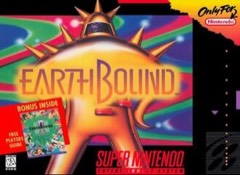
A meteorite lands on a hill above a quiet American-style town, and a boy named Ness walks up in his pyjamas to have a look. By the end he has crossed a continent, gathered three friends, Paula, Jeff and Poo, and faced Giygas, a cosmic force of pure hostility. Along the way he fights runaway dogs, hippies, taxi cabs and a pile of vomit. EarthBound is the second game in Nintendo's Mother series, and it is the strangest role-playing game on the console.
It plays like a classic turn-based RPG with its own twists. Enemies walk around the map rather than ambushing you at random; touch them from behind and you strike first. Once you outclass an enemy, the game skips the battle and hands you the win. Hit points count down on a rolling odometer, so a mortal blow gives you a moment to heal before the number reaches zero. Your dad deposits prize money into a bank account you draw from at ATMs, and he's the one you phone to save.
Where it sits in history
Writer and director Shigesato Itoi, an author and advertising copywriter, spent five years making it with Ape and HAL Laboratory. The project was repeatedly close to cancellation until Satoru Iwata, later Nintendo's president, joined as producer and lead programmer. It grew from an 8-megabit plan to a 24-megabit cartridge. Keiichi Suzuki and Hirokazu Tanaka wrote a score that ranges across salsa, reggae and dub.
Mother 2 came out in Japan in August 1994 and sold 518,000 copies. The North American release, retitled EarthBound, arrived on 5 June 1995 with a $2 million campaign built on the slogan "This game stinks" and scratch-and-sniff adverts. It sold about 140,000 there, and Europe never got it. The fans who did play it kept it alive for years until Nintendo re-released it in 2013.
How it plays today
It is funny, warm and genuinely odd in a way games still rarely manage. The seamless world, with no overworld map between towns, makes every place feel like somewhere people live. The rolling hit points add real tension to boss fights, and the auto-win for weak enemies removes most of the grind that dogs other games from the period.
Some old-fashioned friction remains. Inventory space is tight, you'll juggle items constantly, and the difficulty jumps sharply in places. The early hours are slow to get going. Stick with it: the last stretch, and the final battle especially, rank among the most affecting things on the SNES.
Compared with
- Mother: The Famicom original has the same modern-day setting and humour, with far more grinding and random battles.
- Final Fantasy VI: The same year's other great SNES role-playing game: operatic, fantastical and grand where EarthBound is small, suburban and sly.
- Super Mario RPG: Legend of the Seven Stars: Both bring humour and a light touch to SNES role-playing, but Mario RPG leans on timed hits, EarthBound on writing.
Why it matters
Ness walks up a hill in his pyjamas to look at a meteorite, and from then on saves the game by phoning Dad, who also pays prize money into the bank account. EarthBound ends at a cosmic force of pure hostility, and all the way there it keeps reminding you who is on the other end of the line.
Tim Wildschut and colleagues found nostalgia is mostly positive, often features close others, and raises social connectedness and self-regard. EarthBound seems to have known it a decade early. Its comfort comes from people: a family on the phone, three friends who stay. Its own history reads like the finding in action. It sold about 140,000 copies in North America, Europe never got it, and the fans who played it kept it alive for years until Nintendo re-released it in 2013. A community formed around a shared memory of a small, odd game, and the memory held them together. Remembering together is one of the ways we stay together.
Read: Why old games feel like home →
- Wildschut, T., Sedikides, C., Arndt, J., & Routledge, C. (2006). Nostalgia: Content, triggers, functions. Journal of Personality and Social Psychology, 91(5), 975-993. doi:10.1037/0022-3514.91.5.975
What you're levelling up
You have been training these without noticing. Here is how to do it on purpose, and where it pays off away from the couch. All the skills games teach →
Keeping your cool
In the game. Hit points roll down like an odometer, so a mortal blow gives you a few seconds to heal before the number hits zero. Panic and you waste them.
Do it on purpose. Next boss fight, when a big hit lands, take a breath and pick the right heal instead of mashing. Count how many times the odometer saves you.
Off the couch. When something goes wrong at work there's nearly always a bit of time before it's a disaster. Stay level, use it, and you're the one who has it handled.
Curiosity
In the game. There's no overworld map between towns, so every place feels lived in. You fight hippies, runaway dogs, taxi cabs and a pile of vomit, and the oddest bits sit off the main road.
Do it on purpose. In each new town, talk to everyone and walk every back street before you chase the story. Write down the funniest line you find.
Off the couch. Being into odd, specific things makes you more interesting, not less. Ask your date about the weird thing they love and you'll get the best conversation of the night.
Story sense
In the game. You save by phoning Dad, he pays your prize money into the bank, and three friends stick with Ness all the way to Giygas. It's funny for hours, then the ending hits hard.
Do it on purpose. Read every line, no mashing. After a session, tell someone the funniest bit in thirty seconds and see if it lands.
Off the couch. A good yarn at the pub lives on the oddly specific detail. EarthBound is a masterclass in knowing which detail is the funny one.
Verdict · 9/10
A funny, lonely, one-of-a-kind role-playing game that deserved far better than it got in 1995. Play it for the writing and stay for the ending.