What it was
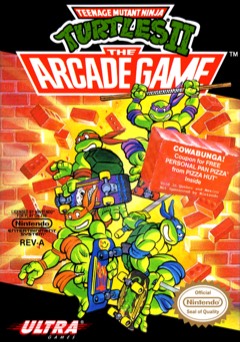
A side-on beat 'em up. Shredder has taken April O'Neil and Splinter, and the four Turtles go after them. Bash parking meters, fire hydrants and oil drums into the enemy, or throw them into walls. Leonardo is the all-rounder, Donatello hits slowly but reaches far, Michelangelo and Raphael are quick and short. Jump and attack together for a special move.
The Foot Clan come in colour-coded waves, each colour with its own weapon and habits, and some grab you and drain your health while the rest pile in. The bosses are the cartoon cast: Bebop, Rocksteady, Baxter Stockman, Krang and Shredder himself.
Where it sits in history
Konami's arcade game came out in 1989 and was a huge hit: the top-grossing dedicated arcade game of 1990 in the United States, with four players fighting side by side. The NES port followed in 1990, titled Teenage Mutant Ninja Turtles II: The Arcade Game so nobody would confuse it with the first NES Turtles game. Ultra Games published it in North America; in Japan the Famicom version was simply Teenage Mutant Ninja Turtles, because the first NES game had gone out there under another name.
It is more than a copy. Konami added two new stages, the first half of Scene 3 and all of Scene 6, with new enemies and two bosses made just for this version: Tora, a polar-bear-like beast, and Shogun, a robot samurai. Most of the arcade stages were lengthened, and the parking garage now ends with Baxter Stockman in his fly form. Pizza Hut logos sit in the backgrounds, and the manual carried a coupon that ran out at the end of 1991.
It sold over 600,000 copies in the two weeks before Christmas 1990 and passed a million in 1991.
How it plays today
It is loud, simple and good fun with a friend. The NES cannot match the arcade's crowds or colour, but the new stages give it something the coin-op never had, and the extra bosses are worth meeting.
Alone, the fights get repetitive and the grab-and-drain enemies are a nuisance. Pick a Turtle that suits you, learn the special move, and play it the way it was meant to be played: shoulder to shoulder.
Compared with
Why it matters
Goffman wrote that a game builds a small shared world with its own rules about what matters, and that being absorbed in it together is what makes an encounter feel alive. Turtles II is that idea in a cartridge. Four brothers, a cartoon everyone watched, and the unspoken rule that you go back for whoever is being held by a Foot soldier.
Nobody remembers their score. People remember who sat beside them.
Read: The second controller →
- Goffman, E. (1961). Encounters: Two Studies in the Sociology of Interaction ('Fun in Games').
What you're levelling up
You have been training these without noticing. Here is how to do it on purpose, and where it pays off away from the couch. All the skills games teach →
Teamwork
In the game. Some of the Foot grab you and drain your health while the rest pile in. That's when a second Turtle earns his pizza.
Do it on purpose. Agree before you start: one of you takes the grabbers, the other takes the crowd. Swap each stage and see which way you lose less health.
Off the couch. Splitting the jobs is how share houses and moving day go smoothly. Saying 'I've got this' and doing it makes people want you on their side, mates and dates alike.
Pattern recognition
In the game. The Foot Clan come in colour-coded waves, each colour with its own weapon and habits. Learn the colours and you know what's coming before it swings.
Do it on purpose. Pick one colour of Foot and just watch it for a stage. Name its habit, then fight it only the way that habit allows.
Off the couch. People come in types too: the mate who's always late, the colleague who says yes then doesn't. Spot it early and save yourself heaps of grief.
Hand-eye coordination
In the game. Donatello hits slowly but reaches far, Michelangelo and Raphael are quick and short. Every hit is about spacing your Turtle exactly right.
Do it on purpose. Play a stage as Donatello and keep every enemy at the very end of his reach. Note each hit you take from standing too close.
Off the couch. Knowing your range is handy in sport, in a crowded kitchen and in a packed pub. It's a physical kind of confidence.
Verdict · 7/10
An arcade smash carried home with extra stages and extra pizza. Best with two on the couch.