What it was
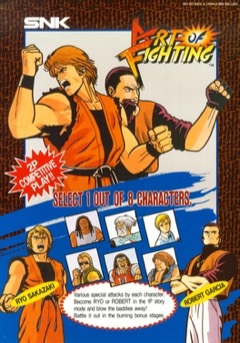
Art of Fighting began as a Neo Geo arcade game from SNK in 1992, and the Super NES version is a port of it. You pick Ryo Sakazaki or his best mate Robert Garcia, two karate students who fight their way through South Town to find Ryo's kidnapped sister, Yuri. It isn't a tournament. It's a rescue, and the game tells it between fights.
The fighting has a few ideas other games hadn't tried. There's a spirit gauge under your health bar. Every special move drains it, and a weaker gauge means weaker specials. Taunting an opponent drains theirs, which is a rude but real tactic. When your health is low and the bar is flashing, you can pull off a Desperation Move. You can also learn a super attack by clearing one of the bonus rounds.
Then there's the camera. As the two fighters close in, the view zooms to show off the sprite detail, and as the fight goes on the characters get bruised and cut. In early development the zoom was so extreme that you only saw them from the knees up.
Where it sits in history
Director Takashi Nishiyama left Capcom after Street Fighter and took planner Hiroshi Matsumoto and most of his team to SNK. Matsumoto wanted a fighting game with a strong story, and directed this one. The cast was built as a nod to Capcom's fighters. Ryo was modelled on Patrick Swayze, and Robert on Steven Seagal and Andy Garcia. The character King was shaped in part on Grace Jones as May Day in A View to a Kill, then ended up more androgynous.
The Super NES version came out in Japan as Ryūko no Ken on 29 October 1993, and Takara published it in North America in December 1993 and in the PAL regions the same year. Monolith Corporation is credited as developer. Many of the home ports made small changes to the gameplay, story or graphics, so don't expect the arcade game one for one.
Critics were split. They liked how it looked and disliked how it played. Nintendo Life called it a poor effort from SNK that couldn't stand next to Street Fighter II, with few characters, limited gameplay and a tough computer opponent. GameSpot rated the graphics among the best on the Neo Geo and called the gameplay nearly devoid of soul. IGN agreed on both counts. Even so, the game gave fighting games the super gauge, super moves, taunts, dashes and zooming screens, and it led straight into the crossovers that became The King of Fighters.
How it plays today
It's a game with a great poster and an awkward grip. Special moves need specific conditions, the computer fights back hard, and you only get two heroes in the story mode. It rewards patience more than fast hands.
Play it for what it started. The bruised faces, the zoom and the desperation moves all feel like the first draft of everything fighting games did next. Come at it as a curio and it's a good time. Come at it expecting Street Fighter II and you'll bounce off.
Compared with
Why it matters
Art of Fighting wanted to tell a story in a genre that mostly gave you a ladder of opponents. Matsumoto said he was trying to reach people who didn't usually play games by showing the story in the game itself. That's a small act of welcome, and it's a good reminder that most of us come into a hobby through a door someone else left open.
Ericsson and colleagues argued that expertise grows through deliberate practice: effortful work aimed at a specific weakness, with feedback. A game that makes you manage a spirit gauge, a taunt and a desperation window is asking for exactly that. It doesn't forgive, and it can feel unfair, but it hands you a clear thing to get better at.
Read: Who you are when you play →
- Ericsson, K. A., Krampe, R. T., & Tesch-Römer, C. (1993). The role of deliberate practice in the acquisition of expert performance. Psychological Review, 100(3), 363-406. doi:10.1037/0033-295X.100.3.363
What you're levelling up
You have been training these without noticing. Here is how to do it on purpose, and where it pays off away from the couch. All the skills games teach →
Planning ahead
In the game. Every special move spends your spirit gauge, so a flurry now means weak fireballs later.
Do it on purpose. Play a match where you only use specials when your gauge is full. See how it changes your pace.
Off the couch. Budgeting, training blocks, a week of work. Spend your energy like it's a gauge, not a tap.
Reading people
In the game. Taunting drains your opponent's spirit gauge, so you're always guessing whether they'll rage or reset.
Do it on purpose. Watch a fight for what the other player does after being taunted. Use it next round.
Off the couch. Haggling at a garage sale: a cheeky lowball tells you fast whether the seller rattles or holds firm.
Keeping your cool
In the game. Desperation Moves only unlock when your health is low and the bar is flashing, so panic is the thing to avoid.
Do it on purpose. Let your health get low on purpose in practice and land the move calmly.
Off the couch. Exams, hard conversations, a flat tyre on the highway. Steady hands win.
Verdict · 6/10
A clumsy fighter with big ideas and a lot of influence. Worth a go as a piece of history, but not your first pick for a Saturday arvo.