What it was
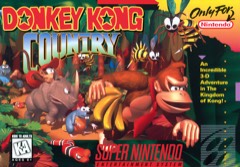
King K. Rool and his Kremlings steal Donkey Kong's banana hoard, and Donkey and his nephew Diddy go to get it back across 40 side-scrolling levels. You control one Kong at a time with the other trailing behind; take a hit and the partner steps in, lose both and you lose a life. Donkey is heavy and hits hard, Diddy is quick and light.
The levels move through jungle, reefs, caves, mines, snow and factories, with runaway minecarts, barrel cannons and rope swings along the way. Animal buddies change the rules for a stretch: Rambi the rhino charges through enemies, Enguarde the swordfish owns the water, Squawks the parrot lights up a dark cave. Bonus rooms hide in almost every level, and finding them all pushes the completion count to 101 per cent.
Where it sits in history
Rare, the British studio run by Tim and Chris Stamper, had sunk its NES profits into Silicon Graphics workstations. Nintendo wanted an answer to Sega's Aladdin, and the Stampers pitched a platformer built from pre-rendered 3D models squeezed into SNES sprites. A team of 12 worked on it for 18 months; Shigeru Miyamoto, busy on Yoshi's Island, contributed ideas but did not direct. David Wise wrote most of the music.
Nintendo revealed it at the June 1994 Consumer Electronics Show, spent a reported US$16 million marketing it in America, and released it in November. It was the fastest-selling game of its time, reached 9.3 million copies, and helped keep the SNES relevant as the PlayStation and Saturn arrived.
How it plays today
Better than its detractors claim. The levels are built for momentum, with enemies and barrels placed so a confident player can run a whole stage without stopping, and the difficulty climbs steadily to some properly tense late stages. Swapping Kongs gives you a buffer that keeps it fair. The music is superb and has aged better than anything else in the package.
The visuals are the divisive part. In 1994 they were astonishing; today some backgrounds look flat and plasticky, and the sprites can make it hard to judge exactly where an edge is. The bosses are simple and repetitive. Some critics in the 2000s called the play underneath unremarkable and the whole thing overrated. That goes too far.
Compared with
Why it matters
Donkey Kong Country is built for the run where you never stop. Barrels sit where your momentum will carry you, enemies line up for the roll, and a confident player can cross a whole stage in a single breath. When it works, you are not thinking about the controller at all.
Mihaly Csikszentmihalyi called that state flow: absorption when challenge matches skill, with clear goals and immediate feedback, self-consciousness gone and time bent out of shape. Rare laid the levels out almost like a score for it. The difficulty climbs steadily, so skill and challenge rise together, and the second Kong acts as a buffer, so one slip does not break the spell. The critics who later called the play underneath unremarkable were half right: no single piece of it is new. But flow does not need novelty. It needs the right things in the right place at the right speed, with David Wise's music playing while you get there.
Read: The zone: why good games make time disappear →
- Csikszentmihalyi, M. (1990). Flow: The Psychology of Optimal Experience.
What you're levelling up
You have been training these without noticing. Here is how to do it on purpose, and where it pays off away from the couch. All the skills games teach →
Timing and rhythm
In the game. The levels are built for momentum, with enemies and barrels placed so a confident player can run a whole stage without stopping. Barrel cannons and rope swings all want a beat.
Do it on purpose. Pick one level and try to clear it without stopping once. Count how many times you hesitated.
Off the couch. Momentum in a conversation is a timing thing. Don't rush it, don't stall, and it flows. Works on a date and in a pitch.
Bouncing back
In the game. Take a hit and your partner Kong steps in; lose both and you lose a life. The late stages get properly tense.
Do it on purpose. When you lose a Kong, slow down for the next ten seconds instead of rushing to the next barrel.
Off the couch. One bad thing doesn't have to become two. Bomb a job interview? Don't let it ruin the date that night.
Curiosity
In the game. Bonus rooms hide in almost every level, and finding them all pushes completion to 101 per cent.
Do it on purpose. In every level, check one wall or pit you'd normally skip. Count how many secrets turn up.
Off the couch. Ask one more question than you normally would. Curious people end up with better stories, better friends and better dates.
Verdict · 8/10
A handsome, well-paced platformer with a great soundtrack, overshadowed by its own sequel. Still worth playing, just not the revolution it looked like.