What it was
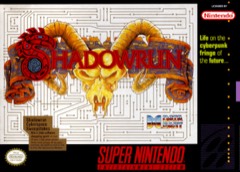
You wake up in a morgue in Seattle, 2050, with no memory and a hole where your life used to be. You're Jake Armitage, shot dead in the street at the start of the game and, somehow, not quite dead. A shamanistic dog turns up to give you a warning, then vanishes. Everyone wants you gone and you don't know why. Beam Software, a Melbourne studio, built it for Data East from the FASA tabletop game, and the story is loosely based on the novel Never Deal with a Dragon.
It's a real-time action RPG, played from an isometric view with a cursor you slide around the screen. Point it at a door, an object, a person or a target and act. Talking to people works like nothing else on the console at the time: new words you hear get highlighted and saved to a bank, and you ask people about them. That's the only way forward. Hit a computer with your cyberdeck and the game flips to a top-down hacking view, where dying means dying in the real world too. Hired shadowrunners can tag along if you've got the nuyen.
Where it sits in history
The SNES project had a rough life between 1989 and 1993. Adam Lanceman got the licence for the tabletop game. Gregg Barnett led it until he left Beam mid-development to start Perfect Entertainment in the UK. The game was halted, then picked up again in late 1992 with a very short deadline. Pauli Kidd, who'd written, directed and designed Beam's Nightshade in 1992, became lead designer. By her account the team had around five and a half to six months to finish, and she brought across Nightshade's film noir feel: dark cityscapes, heavy dialogue and a dose of humour.
The first version of the ROM had a cruder, nastier script. The distributor wanted the lighter one, and the developers fought over it. Kidd said the studio was close to a war between the people making games and the people managing them. It shipped on time anyway. North America got it in May 1993, PAL regions in August 1993 (self-published by Beam as Laser Beam Entertainment), Japan in March 1994 with a longer intro.
Critics loved it. VideoGames, Electronic Games and Game Informer named it Best RPG of the Year, and Nintendo Power called it one of the best sci-fi games ever. It still sold poorly, partly because of low shipping numbers. It's been called ahead of its time ever since, with IGN crediting it for bringing film noir style into games. Harebrained Schemes later wrote Jake into Shadowrun Returns.
How it plays today
The keyword conversations are the best thing here. You're not picking from a menu, you're deciding which word to chase and who to ask. It feels like detective work, and a clue you overheard ten minutes ago can crack a stranger open. Hunting down the next lead is the whole game.
The weak spot is combat. Almost every screen has a hidden gunman who opens fire from somewhere random, and you spend a lot of time spotting where the shots are coming from. It's tense and sometimes just annoying. It's also a game where you need to read what the characters tell you, so don't skip the dialogue. If you want a moody SNES RPG that isn't Final Fantasy with a different coat of paint, this is it.
Compared with
- Nightshade: Beam's 1992 game. Same lead designer, and the noir feel Shadowrun carried over.
- Secret of Mana: The game that beat it to GamePro's Best RPG of the year, with a very different mood.
- EarthBound: Another SNES RPG that picks a strong, strange tone and sticks with it.
Why it matters
Jake doesn't know who he is, and the game won't just tell you. You find out the way you'd find out anywhere else: by asking questions, following leads and putting up with not being sure. D. W. Winnicott wrote about play as the space between your inner world and the outer one, where people get creative and find a self. Shadowrun is that idea with a gun in it.
Because the words are yours to choose, the story belongs a bit to you. Two players can end up with the same Jake and have walked two different paths to him.
Read: Who you are when you play →
- Winnicott, D. W. (1971). Playing and Reality.
What you're levelling up
You have been training these without noticing. Here is how to do it on purpose, and where it pays off away from the couch. All the skills games teach →
Reading people
In the game. Every new word you overhear goes into a bank, and asking the right person about the right word is the only way to move the story along.
Do it on purpose. Before you talk to anyone, say which word you're going to ask and why that person.
Off the couch. Interviews, awkward family dinners, first dates. Knowing what to ask who is half the job.
Problem solving
In the game. Info is scattered in computers and conversations. You piece the plot together from fragments hacked out of protected systems.
Do it on purpose. Keep a scrap of paper with names and leads, and cross them off as they pay out.
Off the couch. Chasing a billing error, a dodgy invoice or a mate's dud car. You work the trail until it makes sense.
Judging risk
In the game. Hidden gunmen on nearly every screen. Retreat, or find the shooter and hit back? Dying in cyberspace kills Jake for real, so you weigh up every hack.
Do it on purpose. Play one stretch asking yourself before each jack-in: is this worth it right now?
Off the couch. Money, career moves, a risky overtake. Know what you can afford to lose before you go in.
Verdict · 8/10
A dark, clever RPG that treats talking as the main weapon. Rough in the fights, brilliant in the conversations, and proof Melbourne could do it.