What it was
In 1988, a poltergeist attacks a boy's house. His name is Ninten, and his father tells him his great-grandfather studied psychic powers and asks him to look into the odd things happening across America. So a kid with a baseball bat sets out through towns with names like Mother's Day and Valentine, gathering eight melodies for a queen who hears them in her dreams, and picking up friends: Lloyd, a bullied boy genius; Ana, a girl with psychic powers looking for her mother; and Teddy, a gang leader.
Mechanically it is Dragon Quest in modern clothes: random battles in first person, menus and levels. The difference is the dressing. You heal at hospitals and with fast food, fight hippies, zombies, possessed objects, robots and aliens, travel by train, and save by phoning your dad, who also pays money into your bank account after battles.
Where it sits in history
Copywriter Shigesato Itoi fell for Dragon Quest in 1987 and wanted to make a role-playing game set in his own time, not a medieval fantasy. He pitched it to Shigeru Miyamoto, who at first doubted him and told him to go away and simplify, then called back with a team. Itoi wrote the script, borrowing from Spielberg's films for mood, and named the game after John Lennon's song. Keiichi Suzuki wrote pop songs for it, with real lyrics recorded for an album, and Hirokazu Tanaka programmed the music.
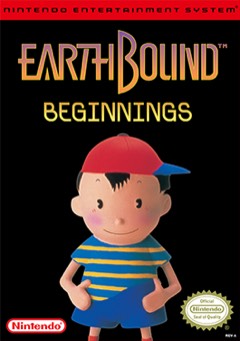
Nintendo released it on the Famicom in Japan on 27 July 1989, and it sold about 400,000 copies, the sixth best-selling game of the year there. An English version called Earth Bound was finished and advertised for 1991, then shelved as unprofitable. A prototype surfaced in 1998 and circulated online as EarthBound Zero. Its sequel became EarthBound on the SNES, and the first game finally came out in English, as EarthBound Beginnings, in 2015.
How it plays today
Its charm has not faded. The writing is warm and odd, the setting still feels unlike any other 8-bit RPG, and the music, especially the Eight Melodies that tie the story together, is gorgeous. There is a real sense of childhood adventure in it, of a kid who might be pretending to be a hero, and the ending still hits.
The balance is another matter. Random battles come often, many enemies hit hard, and the game expects a lot of grinding. Directions are vague, the map is large, and the first-person battles are plain to look at. Critics at the time and since have called it too hard and unevenly balanced, and EarthBound took the same ideas and did them better. Play it for the story and the mood, and use a guide.
Compared with
- EarthBound: The SNES sequel refines almost every idea here, with fairer balance and sharper jokes; play that first if you only play one.
- Dragon Warrior: The template Mother follows and parodies, with swords and castles where Mother has baseball bats and trains.
- Crystalis: Another NES RPG that looks past medieval fantasy, set a century after a nuclear war instead of in 1980s America.
Why it matters
Shigesato Itoi wanted a role-playing game set in his own time, not a medieval fantasy, and Mother is what came of it. The hero carries a baseball bat, heals with fast food and saves by phoning his dad. It is a child's summer, stretched across America and bent by aliens, and it feels like being small again.
Tim Wildschut and colleagues found nostalgia is mostly positive, often features close others, and raises social connectedness and self-regard. Mother seems to know that. The Eight Melodies are tunes gathered for a queen who hears them in her dreams, and the friends Ninten makes on the way, Lloyd the bullied genius and Ana looking for her mother, are the close others memory keeps. English speakers waited from a shelved 1991 release to 2015 to play it officially, and many arrived already fond of EarthBound. Missing something you never had is its own strange, warm ache.
Read: Why old games feel like home →
- Wildschut, T., Sedikides, C., Arndt, J., & Routledge, C. (2006). Nostalgia: Content, triggers, functions. Journal of Personality and Social Psychology, 91(5), 975-993. doi:10.1037/0022-3514.91.5.975
What you're levelling up
You have been training these without noticing. Here is how to do it on purpose, and where it pays off away from the couch. All the skills games teach →
Story sense
In the game. A kid with a baseball bat gathers eight melodies across towns like Mother's Day and Valentine, picking up Lloyd, Ana and Teddy. The writing is warm and odd, and the ending still hits.
Do it on purpose. Pick one friend and pay attention to everything they say. Ask yourself what they want from the trip.
Off the couch. Seeing the world from someone else's shoes makes you better company. On a date it's the difference between a conversation and an interview.
Bouncing back
In the game. Random battles come often, many enemies hit hard, and the game expects a lot of grinding.
Do it on purpose. When a fight wipes you out, phone Dad to save more often and grind a few levels near a hospital before pushing on.
Off the couch. Sometimes the answer is just more reps. At the gym, in a new job, in saving up. Boring, but it works.
Planning ahead
In the game. Directions are vague and the map is large. You heal at hospitals and with fast food, and you save by phoning your dad.
Do it on purpose. Before heading somewhere new, stock up on fast food and save. Plan your route back to the last hospital.
Off the couch. Packing water and a charger before a road trip is boring and smart. Planning ahead makes the fun bits possible.
Verdict · 7/10
A lovely, strange and moving RPG buried under a grind that has aged badly. Worth playing for anyone who loved EarthBound.