What it was
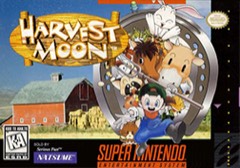
A farm game on a console full of fighting games. You inherit your grandfather's run-down farm and spend each day deciding what matters: clearing rocks and stumps, planting and watering crops, selling the harvest, feeding chickens, brushing and milking cows, foraging, and turning up to the town's festivals. Crops do not die without water, they just stop growing. Cows that go unfed can fall sick, and chickens left outside can be lost to a storm or wild dogs.
Behind the chores runs a slower goal: getting to know the villagers, and courting and marrying one of the women in town. After dark only the bar is open, where the regulars gather to talk.
Where it sits in history
Director Yasuhiro Wada came up with it in his first years in Tokyo, missing his country childhood in Miyazaki. He wanted a game unlike the fighting games of the day and feared it would fail because nothing like it existed. His team set three rules: no fighting, unique, and tactile real-time action. Early versions centred on herding cows and were dull, so the cows were simplified and land-clearing and planting added, partly inspired by how The Legend of Zelda let you change the ground around you.
Eight to ten people at Pack-In Soft worked on it for three years. Late in development the parent company went bankrupt, most of the staff left, and the last six months were done by three people: Wada, programmer Tomomi Yamatate and designer Setsuko Miyakoshi. It came out in Japan on 9 August 1996, after the PlayStation and Nintendo 64 had launched. Only 20,000 copies sold at first; word of mouth took it past 100,000 in Japan. Natsume brought it to North America in 1997 and Nintendo to Europe on 29 January 1998. The localisation turned all the alcohol into 'juice', though anyone who drinks it still ends up drunk.
How it plays today
It is slower and stiffer than the farm games it led to, and the first weeks are hard work: you are poor, the field is rubble, and the day ends before your chores do. That is the point, and it does not take long to feel it. A Famitsu reviewer put it well: the game makes you excited about what you will do tomorrow.
Play it in seasons, not hours. Plant something, look after one cow properly, go to the festival. The pixel art has aged beautifully, and the quiet is still rare.
Compared with
- SimCity: The other great SNES game about tending a place, from far higher up.
- ActRaiser: The SNES's other game about tending a place and watching it grow, half town-building and half sword fights. Harvest Moon kept the tending and dropped the fighting.
- The Legend of Zelda: The 1986 original, whose ground you could change around you. Wada took that feeling and turned it into clearing a farm.
Why it matters
Harvest Moon was built from homesickness. A young man in a big city remembered the countryside and made a game where the reward is tending something until it grows. Wildschut and colleagues found that nostalgia is mostly warm, often centres on the people we love, and leaves us feeling more connected. Wada put that feeling into a cartridge, and three people kept going after the company folded to finish it.
It proved that a game can be about care rather than conquest, and that people want that. Watering a field every morning is not an obstacle anyone needed, but we choose it, and the field grows, and so do we.
Read: Why old games feel like home →
- Wildschut, T., Sedikides, C., Arndt, J., & Routledge, C. (2006). Nostalgia: Content, triggers, functions. Journal of Personality and Social Psychology, 91(5), 975-993. doi:10.1037/0022-3514.91.5.975
What you're levelling up
You have been training these without noticing. Here is how to do it on purpose, and where it pays off away from the couch. All the skills games teach →
Planning ahead
In the game. Every day you decide what matters: rocks and stumps, crops, the cows, foraging, a festival. The day ends before your chores do.
Do it on purpose. Each in-game morning, pick the three jobs that matter most and do those first. Note what fell off the list.
Off the couch. Real weeks are the same: the day ends before the chores do. Do the three that matter first and the rest can wait.
Systems thinking
In the game. Crops without water don't die, they just stop growing. Unfed cows can fall sick, and chickens left out can be lost to a storm or wild dogs.
Do it on purpose. Change one routine, like seeing to the animals before the field, and watch a full season for what else shifts: money, time, the herd.
Off the couch. Sleep, food and exercise work like the farm: skip one and the others quietly stop growing. Fix the system, not just the bad day.
Reading people
In the game. Behind the chores runs a slower goal: getting to know the villagers and courting one of the women in town. After dark only the bar is open, where the regulars gather to talk.
Do it on purpose. Visit the same few villagers every day for a week and notice what each one lights up about. Then turn up to the festival.
Off the couch. Turning up, remembering what they care about, being steady: that's courting, in the game and out of it. Nobody falls for someone who only shows up on festival day.
Verdict · 8/10
One of the first games to make chores feel like a gift, and the root of a whole genre. Slow by design, and better for it.