What it was
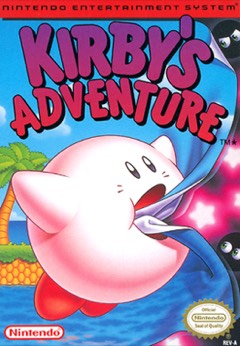
Swallow an enemy, take its power. That one idea, the Copy Ability, is what Kirby's Adventure brought to the series, and it became the series staple. Some powers open new routes, some change how a whole level plays. Get hit and the power drops away, and you have a moment to grab it back before it is gone.
Around that sits a friendly platformer of 41 levels across seven worlds. Each world has a hub room of doors, a boss, minigames for extra lives, and arenas where you beat a miniboss to take its ability. Kirby can inflate and fly over most gaps, so the game is less about precise jumping than about which power to carry into the next room. Progress saves after each level.
Where it sits in history
HAL Laboratory built it as a follow-up to Kirby's Dream Land on the Game Boy, with Masahiro Sakurai directing again and Satoru Iwata and Shigeru Miyamoto among the producers. Sakurai was first asked to port the Game Boy game, then chose to make a new one for more experienced NES players. It was also the first time anyone saw Kirby in colour, and Sakurai had always meant him to be pink.
Nintendo published it in Japan on 23 March 1993, in North America that May and in Europe in September, ten years after the Famicom launched and well after most players had gone 16-bit. It topped the Famitsu sales chart anyway, won GamePro's NES game of the year, and introduced Meta Knight.
How it plays today
It looks astonishing for the hardware: parallax backgrounds, big colourful sprites and smooth animation that make earlier NES games look sparse. There is some slowdown when the screen fills, but the controls stay responsive and the abilities are a joy to try on every new enemy.
The honest catch is that it is easy. Flight removes most of the danger from platforming, and an experienced player will clear it in a few evenings. The hidden items that unlock extras give it a second life, and it makes a strong first NES game for a younger player sitting next to you.
Compared with
- Super Mario Bros. 3: Both are late, lavish NES platformers; Mario asks more of your hands, Kirby asks you to experiment.
- Kirby Super Star: The SNES follow-up builds whole modes around the copy abilities this game invented.
- Mega Man 2: The other NES game about taking an enemy's power, though Mega Man makes you earn it with a boss fight.
Why it matters
Kirby is a pink blank until it eats something. Swallow one enemy and you breathe fire; swallow another and you swing a sword. The game hands you a new body every few rooms, and you play differently in each: bolder with a blade, fussier with something delicate.
Nick Yee and Jeremy Bailenson called this the Proteus effect: people's behaviour shifts to match the avatar they are given. Kirby's Adventure turns that finding into a toy. You don't just use a power, you become the kind of player it suits, then lose it on the next hit and become someone else. It also makes a gentle first game for a small person on the couch beside you. Lev Vygotsky saw that in play a child acts a head taller than themselves, stretched just past what they can already do. Flight means a young player rarely falls behind, so a five-year-old ends up beating a boss that looked impossible an hour ago. That is not easy mode. That is growing.
Read: Who you are when you play →
- Yee, N., & Bailenson, J. (2007). The Proteus effect: The effect of transformed self-representation on behavior. Human Communication Research, 33(3), 271-290. doi:10.1111/j.1468-2958.2007.00299.x
- Vygotsky, L. S. (1978). Mind in Society: The Development of Higher Psychological Processes.
What you're levelling up
You have been training these without noticing. Here is how to do it on purpose, and where it pays off away from the couch. All the skills games teach →
Problem solving
In the game. Some copy abilities open new routes and some change how a whole level plays. The question in every room is which power you carry in.
Do it on purpose. Replay a level you've cleared and try it with a power you'd normally skip. Note what it opens up that your favourite couldn't.
Off the couch. At work, the tool you always reach for isn't always the right one. Asking what else would work is how you get unstuck.
Curiosity
In the game. Hidden items unlock extras across 41 levels and seven worlds. The game rewards anyone who tries every new enemy's power just to see.
Do it on purpose. Next session, swallow every new enemy you meet, even the ones that look useless. Keep a list of what each one does.
Off the couch. The person who tries the weird dish, takes the odd class, asks the quiet person at the party a question. That's how you end up with stories worth telling.
Judging risk
In the game. Get hit and your copy ability drops away, with a moment to grab it back before it is gone. Do you chase it into danger or let it go?
Do it on purpose. Next level, decide before you start which power is worth chasing after a hit and which you will let float off. Stick to it.
Off the couch. Knowing what is worth going back for, and what to let go, works for old jobs, old flames and that twenty bucks you dropped near the busy road.
Verdict · 9/10
One of the best-looking games on the NES and the birth of Kirby's defining trick. Light on challenge, heavy on charm.