What it was
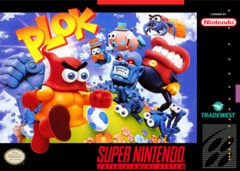
Someone nicked Plok's flag, so the king of Akrillic heads off to find it and comes home to an island crawling with fleas. Clear every flea in a level and the last one drops a flag, which floats up its pole and lets you move on. Your weapons are your own limbs. Two arms, two legs, thrown as projectiles. Hit something and the limb snaps back at once. Miss and it takes a while to return.
Lose all four and you bounce around, which handles worse than it sounds. Some puzzles want you to give a limb up on purpose, hanging it on a hook to flip a switch. Presents turn you into a movie-style hero for a while, a boxer or a cowboy or a flamethrower bloke, and the Fleapit near the end hands you a unicycle with a water cannon, a tank, a jetpack and a flying saucer.
Where it sits in history
It started as Fleapit, an arcade game Ste and John Pickford funded themselves in the late 1980s for Rare's Razz Board hardware. It was cancelled in 1990 when their studio, Zippo Games, closed. Years later it came back as an SNES game at Software Creations, with the Pickfords keeping the rights to the character. Software Creations paid for it themselves.
Nintendo published it in Europe only. Tradewest had North America and Activision had Japan. Shigeru Miyamoto was keen on it while it was half-built. Nintendo never said why it passed; Ste Pickford believes Miyamoto found the race levels too close to Yoshi's Island, which Nintendo had in the works. A Mega Drive port was planned and cancelled. Critics liked it. Sales didn't, and the Pickfords blame a market jammed with mascot platformers.
How it plays today
The thing that holds up is the cheek. Everything is stitched and stuffed and daft, the music is great, and the limb throwing is a proper idea instead of a gimmick. A fair few reviewers at the time were tired of colourful cute platformers and said so, and that's a fair gripe. Plok is a pile of ideas and it doesn't hang together as tightly as Mario does.
But the ideas are good. Feeding a fruit a few punches to grow it before you eat it is the kind of silly touch you remember. Child's Play mode cuts the harder levels, so it's friendly to someone dragged in for a go. If you only know it from Best Of lists, it's worth the cartridge price just to see why people keep shouting its name.
Compared with
Why it matters
Plok asks you to spend a limb to get through a door. It's a small, funny lesson in cost: you can't throw everything at every problem and expect to keep it. Sometimes the best move is to give up something you value to open the next bit of road.
Csikszentmihalyi describes flow as the absorption you get when the challenge matches your skill, with clear goals and quick feedback. Every throw tells you at once whether you hit. Every miss shows its price in the seconds your limb takes to come back.
Read: The zone: why good games make time disappear →
- Csikszentmihalyi, M. (1990). Flow: The Psychology of Optimal Experience.
What you're levelling up
You have been training these without noticing. Here is how to do it on purpose, and where it pays off away from the couch. All the skills games teach →
Judging risk
In the game. Throw a limb and miss, and it takes longer to return. Throw all four and you're left bouncing. Some puzzles make you give a limb up on purpose.
Do it on purpose. Play one level never throwing your last arm. Notice how often you wanted to.
Off the couch. Don't spend your last bit of cash, patience or goodwill on one go. Keep something in the bag.
Problem solving
In the game. Switches only work if you hang the right limb on a hook, and some targets need a specific one. Work out which limb goes where before you chuck it.
Do it on purpose. Before the next hook puzzle, say which limb you'll sacrifice and why. Then try it.
Off the couch. At work or on a date, the answer is often giving something up. Work out what before you start.
Curiosity
In the game. Punch a magic fruit and it grows, healing more the more you hit it. Some fruits send you to bonus areas where a timed run can skip a level or a boss.
Do it on purpose. Punch every fruit you see for one stage. Write down what each one did.
Off the couch. Poke the odd thing. The mate who asks what that is usually finds the best bit of the night.
Verdict · 8/10
A cheeky, inventive platformer that deserved a bigger crowd. Throwing your own limbs and giving one up to open a door still feels fresh.